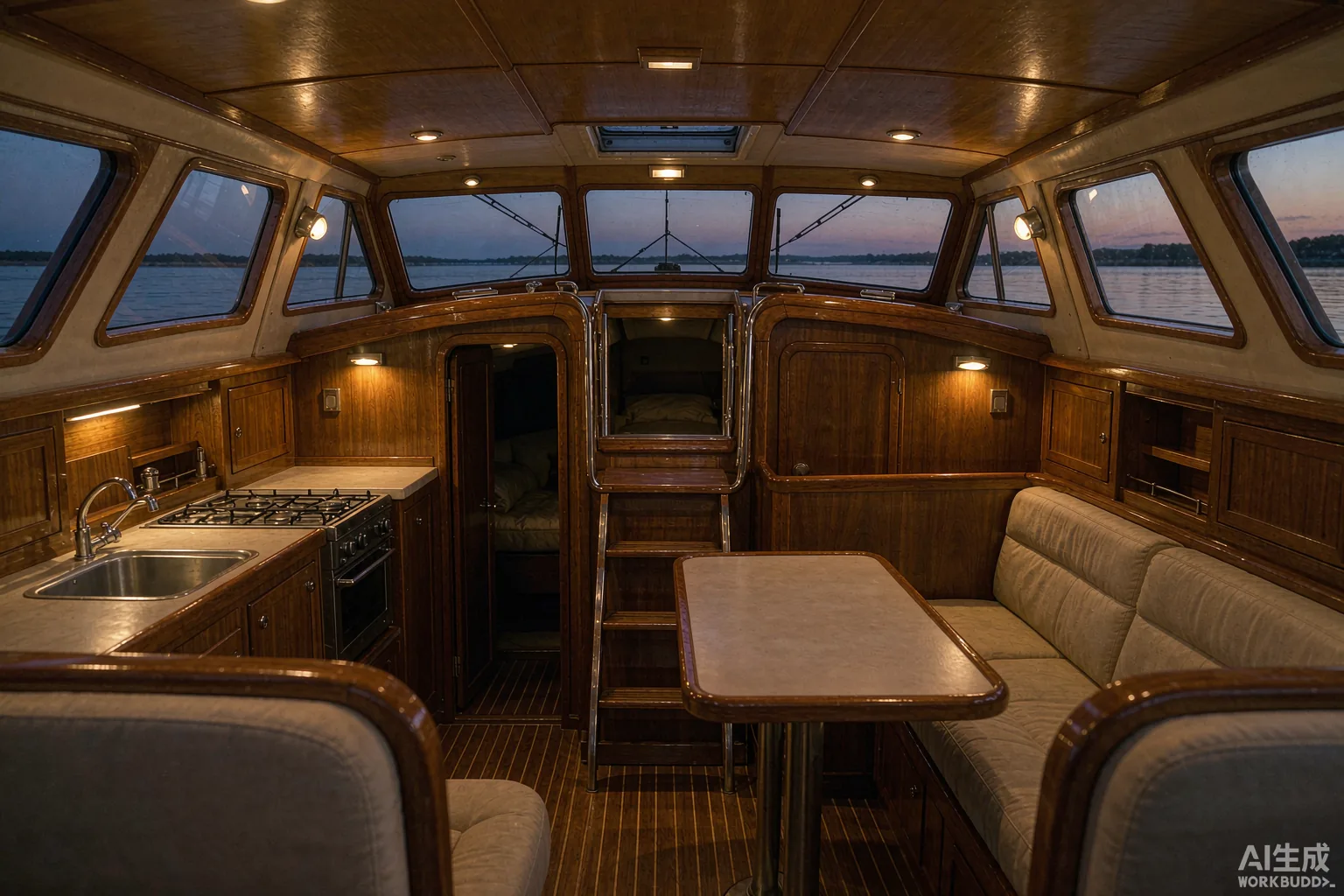
No builder is best at everything, and in 2026 the market splits into three groups that are priced and depreciated differently. Dutch and German custom yards hold roughly 70–85% of their value after ten years. Italian semi-custom builders own the 24–50 m space and quote 30–70% less per metre than the custom yards. High-volume British and American yards sell service networks and second-hand liquidity rather than rarity. The group you choose moves more money than any option list — so start there, then narrow to a yard.
Why resale separates the brands before the spec sheet does
Two 40 m yachts can carry near-identical equipment and still be worth very different money five years later. The difference is structural: how many hulls the yard builds, how uniform those hulls are, and how deep the buyer pool is when you sell. A semi-custom line that ships the same platform twenty-five times creates a price reference that holds values firm; a one-off custom yacht is repriced from scratch on every sale. Published 2026 broker analyses put ten-year retention between roughly 45% and 85% depending on the yard.
| Builder | 5-year retention | 10-year retention | What drives the number |
|---|---|---|---|
| Feadship | 85–90% | 70–85% | Custom only, deepest buyer pool at the top end |
| Lürssen | 82–88% | 68–80% | Ultra-large custom, thin supply |
| Benetti | 72–78% | 55–65% | Semi-custom platform continuity |
| Sanlorenzo | 70–76% | 52–62% | Limited series, strong brand carry |
| Azimut | 65–72% | 48–58% | High volume, very high liquidity |
| Sunseeker | 63–70% | 45–55% | Broad appeal, volume competition on resale |
| Ferretti | 62–68% | 45–55% | Volume production, deep service network |
Read these as yard-level averages, not promises. Model choice, refit history and documented maintenance move the number more than the badge does — the single highest-value thing you can own at resale is a complete service file, which is worth more than any factory option.
The three tiers of the 2026 market — and what each costs
Price bands in 2026 are wide inside every size category because the same length spans production and full-custom platforms. The per-metre figures below are new-build numbers from European yards and exclude designer fees, project management and VAT.
| Tier | Typical LOA | 2026 new-build price | Who builds there | What you pay for |
|---|---|---|---|---|
| Full custom | 50–100 m+ | €25–80M (50–70 m), €60–200M (70–100 m) | Feadship, Lürssen, Oceanco | Engineering and bespoke design, €1.5–5M per metre |
| Semi-custom | 24–72 m | €3–25M (24–40 m), €15–50M (40–50 m) | Benetti, Sanlorenzo, Heesen, Azimut Grande | Platform efficiency: €250k–450k/m in GRP, €500k–900k/m in steel above 45 m |
| Series production | 15–35 m | €0.5–12M | Sunseeker, Princess, Ferretti, Azimut flybridge, Viking | Dealer network, delivery in months, liquid second-hand market |
Two real 2026 numbers show how much the option list and the delivery slot move a price. A Benetti Oasis 40M is quoted near €19.4 million base, and an in-stock 2026 Azimut Grande 36M — twin 2,400 hp MTUs, carbon superstructure — listed at $19.95 million against a base price around $14–15 million. The gap between those two figures is the options and the immediate delivery, which is exactly what a broker should price for you before you sign anything, as set out in the full yacht cost breakdown.
Italian yards: design plus series efficiency
Benetti (Viareggio, building since 1873) is the volume leader among Italian custom and semi-custom yards. The Oasis 40M — open stern, beach club, semi-custom platform — is the reference model at that size in 2026, and the steel B.Now 50 m series starts around €25 million, which is why the yard is usually the first stop between 35 and 50 metres.
Sanlorenzo sells design first. The asymmetric-deck SD118 (35.75 m, €15–18 million base) shipped as a 25-hull series, and that uniformity shows at resale: early hulls from 2020 have been brokering at roughly 80–85% of original delivery price, well above the GRP average. The yard's largest deliveries sit in the 60–70 m range rather than the 100 m tier.
Azimut is the production powerhouse, spanning roughly 34–120 ft with the widest dealer network of the Italian group. The Grande 36M flagship carries a carbon-fibre superstructure and twin MTU 2,400 hp engines. Expect the fastest resale process of the Italian brands, and accept the lower retention that comes with it.
Ferretti covers the flybridge mainstream — the 860 (26.95 m) starts around $9.5 million — and shares group technology with Riva, Pershing and Custom Line.
Northern European yards: engineering first, longer waits
Feadship (Netherlands) and Lürssen (Germany) build custom only, at €2.5–4.5 million and €3–5 million-plus per metre respectively. A 55 m Feadship fast-displacement is indicatively €85–95 million in 2026, and a 70 m explorer from Lürssen starts above €120 million. These yards quote individually above 80 m, where systems integration matters more than length.
Heesen (Oss, Netherlands) bridges the gap: custom and semi-custom aluminium between 40 and 80 m, with a 5000-series aluminium hull indicatively €40–45 million and the 6500-series around €50–60 million. Amels, part of Damen, sells a Limited Editions platform — a 60 m hull indicatively €80–90 million — with shorter delivery than a full custom project. On all of these, expect a two-to-three-year build slot and a staged payment structure backed by a bank refund guarantee; this is where independent representation matters, so read how to choose a broker before committing a deposit.
British and American yards: performance, sportfish and liquidity
Sunseeker (Poole, UK) builds performance motor yachts: the 100 Yacht starts around $10–11 million, twin MTU, roughly 29 knots, and the Predator and Manhattan lines cover 55–95 ft with the strongest British brand recognition in the Mediterranean and Florida.
Princess (Plymouth, UK) competes head-on with a dealer network that spans four continents. The X95 introduced the "super flybridge" layout and starts around $12 million; the Y95 flagship sits near $13 million. Build quality is the argument, price is the lever — British yards have typically quoted 10–15% below equivalent Italian tonnage.
Viking (New Gretna, New Jersey, building since 1964) owns the American sportfish category. A new 64 Convertible runs $5–6 million; in late 2026 a 2024 68 Convertible was asking $6.9 million and a 2006 74-footer $1.8 million. That depth of comparable hulls is the real advantage: you can see what boats actually sold for, which makes negotiation evidence-based rather than guesswork — the opposite of the mistakes most first-time buyers make, covered in yacht buying mistakes to avoid.
Sailing yachts and catamarans are a different shortlist
Almost none of the motor-yacht names above matter if you are buying a sailing boat. The sailing market divides by construction philosophy, and prices at 45–50 ft already span a 1:2 range.
| Segment | Names | 2026 entry price | What holds value |
|---|---|---|---|
| Production cruising monohull, 40–50 ft | Beneteau, Jeanneau, Bavaria | ≈ €450,000–600,000 (Oceanis 46.1, 4-cabin) | Dealer network and charter demand |
| Bluewater semi-custom, 40–50 ft | Hallberg-Rassy, Oyster, Contest | HR 44 from ≈ €758,000, ≈ €1.2–1.3M equipped | Build quality and the owners' network |
| Performance cruiser, 45–60 ft | Solaris, X-Yachts, Nautor's Swan | Used Swan 48s listed ≈ £1.2M in 2026 | Racing pedigree and refit records |
| Catamaran, 45–50 ft | Lagoon, Fountaine Pajot | ≈ €550,000–1,000,000 new | Charter fleet demand; berth surcharges of 60–100% are real |
The hull-type choice is bigger than the brand choice at this size, and it changes berth cost, maintenance and upwind performance at once — the full trade-off is in motor yacht versus sailing yacht.
Six checks before you commit to a yard
- Ask the broker for 5- and 10-year-old sister-hull asking prices. If they cannot produce three comparables, the secondary market for that model is too thin to price your exit.
- Visit during build, not at launch. Systems routing, joinery behind panels and warranty posture show up mid-project, not at the champagne stage.
- Check the service footprint where you will cruise, not where the yard is. A warranty that requires hauling the boat to the builder's home port is not a warranty.
- On new builds, confirm the delivery slot and the refund guarantee. Staged payments should be backed by a bank refund guarantee; anything else is unsecured exposure on a multi-year project.
- Talk to two owners of the same model, ideally one at 200 hours and one at 2,000. After-sales experience is the least consistent category in every yard ranking published.
- Price the running cost before the purchase price. At 8–12% of value a year, the badge changes the annual bill, and the finance offer that looks cheap can shift it further — see yacht financing in 2026.
Frequently asked questions about yacht brands
Which yacht brands hold their value best? The custom Dutch and German yards: published 2026 analyses put Feadship at 70–85% and Lürssen at 68–80% of build price after ten years, with Heesen close behind. Among series builders, Sanlorenzo and Benetti lead at 52–62% and 55–65% respectively.
Is a bigger brand always the safer buy? A bigger brand buys liquidity, not retention. High-volume builders resell fastest because there is always a buyer pool — and depreciate faster for the same reason, because every used hull competes with dozens of sisterships.
How much does a 40 m yacht cost in 2026? Semi-custom from an Italian yard starts near €19–20 million (the Oasis 40M base is quoted around €19.4 million); a fully custom 40–50 m from a Northern European yard runs €15–50 million. Options typically add 15–30%.
New build or brokerage? A maintained brokerage yacht typically trades at 40–70% of its original build cost, and the 2025–2026 market gives buyers more negotiating room than 2021–2022 did. New build buys warranty and a clean specification at the cost of a two-to-three-year wait.