The drip is almost never under the fitting that leaks. Water enters at a stanchion base or a chainplate, runs sideways through the balsa or foam core, and drops out at the lowest point it can reach — usually the hatch rim, three feet away. Re-bedding the hatch then changes nothing. The reliable method is to hose one fitting at a time while someone watches below, confirm the moisture reading, and re-bed with a compound that will still be there in a decade. A neglected leak that comes through a through-hull fitting has produced a $10,000 repair bill on a boat whose owner only noticed a damp locker.
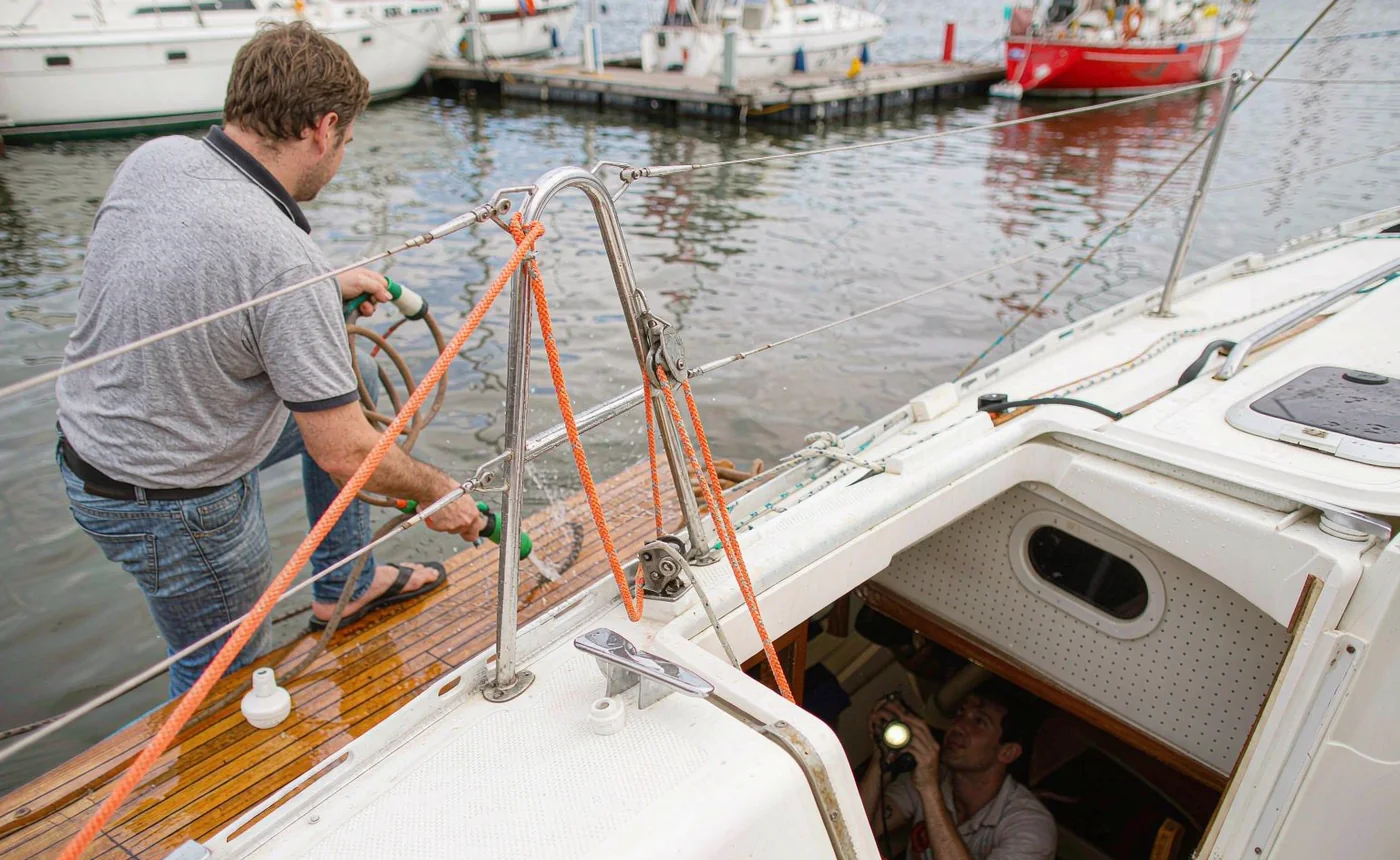
Why the drip shows up three feet from the leak
Most decks on production yachts from the 1980s onward are cored: two skins of glass with end-grain balsa or PVC foam between them. Balsa does not resist water, it drinks it. The cells fill along the grain and the water then spreads laterally through the panel, following the path of least resistance until it finds a hole — a bolt, a wiring penetration, the edge of a hatch cut-out — and drips into the cabin.
Two consequences follow. The visible drip marks the exit, not the entry. And the wet area is almost always larger than the stain — balsa sits at 10–12% moisture by weight when dry and can reach several hundred percent without the panel visibly swelling, which is why a soft deck is a late symptom.
So: find the entry, measure how far the water has spread, then repair. Skipping the first two is why the same hatch gets re-bedded every spring.
The hose test, one fitting at a time
A garden hose and a second person settle in twenty minutes what a year of guessing will not. Work in dry weather, with the cabin stripped enough that you can see the underside of the deck.
- Start at the lowest suspect and work uphill. Water only runs down, so testing a high fitting first can wet the deck and contaminate every result after it. Begin forward and low, finish at the mast or the coachroof.
- Isolate one fitting. Tape a dam of butyl or plasticine around a single stanchion base or cleat so the water pools against it instead of running away.
- Run water for two to three minutes, no more. A trickle is enough; a jet drives water past seals that would survive real rain.
- Have the person below call the time. "Drip starting now" is the data. If nothing appears within five minutes, move on — you can always come back.
- Mark and photograph. Tape a label on the fitting, write the time, and photograph the corresponding wet patch below. When you have tested twelve fittings you will not remember which was which.
If the deck is too far gone for a clean result, dust the underside with talc before testing. Water leaves a visible track through the powder and shows the route it took. Coloured water — a few drops of food dye — does the same job from above, and it is the fastest way to prove a leak to a yard that wants to sell you a full deck job.
The six fittings behind most deck leaks
Deck leaks cluster. On a typical 35–50 ft yacht, most of them come from the same short list, and each fails in a predictable way.
| Fitting | How it fails | What to look for |
|---|---|---|
| Stanchion bases | Lever load on a small footprint cracks the bedding; fasteners work loose | Cracked sealant ring, rust staining at the screw heads, movement when you push the stanchion |
| Chainplates and shroud anchors | Constant load plus salt water; bolts elongate their holes over decades | Brown streaks down the bulkhead below, damp wood at the knee |
| Hatch and portlight rims | Sealant ages out; frames distort with heat | Water tracking along the frame, not through the acrylic |
| Genoa track and jib car bolts | Dozens of fasteners, several inaccessible; one loose bolt is enough | Local softness in the side deck under the track |
| Toe rail and hull-to-deck joint | Mechanical joint flexes; sealant at the ends of the run fails first | Staining at the rail ends, wet headliner near the sheer |
| Windlass, hawse pipe and anchor locker lid | Wet chain and anchor mud sit against the seal permanently | Water in the chain locker, soft deck aft of the windlass |
Two of those deserve special mention because they are invisible and expensive. Chainplate leaks rot the plywood knee or bulkhead they bolt through, and that is structural. Windlass and anchor-locker leaks soak the foredeck core where the deck takes its highest point loads. Check both every season, even when nothing is dripping.
What the moisture meter is actually telling you
A meter is a comparator, not a verdict. It tells you where the deck is wetter than a known-dry reference point on the same boat, and it tells you how far the wet area runs. Surveyors read from inside wherever possible, because a reading taken through the outer skin passes through paint, gelcoat and sometimes a damp surface film before it reaches the core.
| Reading (balsa core) | Usual interpretation | Reasonable response |
|---|---|---|
| Around 10–12% | Normal equilibrium for dry balsa | Nothing; keep it that way |
| 15% and above | The working threshold used in repair practice for calling a balsa area wet | Find and fix the entry; dry and monitor |
| High across a wide area, skin sounding dull | Water has spread and the bond may have separated | Cut and recore; drying alone will not fix delamination |
Tap testing is the cheap companion. A sharp, consistent note means bonded core; a dull thud means the skin has lifted or the core has gone soft. Do it with a small plastic-handled screwdriver, not a hammer, and mark the boundaries with tape. The area you mark is the area you quote.
Rebedding: the sealant choice decides whether you repeat the job
Deck hardware bedding is expected to last seven to ten years. Half of the jobs that fail early fail because of the compound, not the technique.
Silicone is the wrong default. Residue on gelcoat stops later sealants and paint from bonding, adhesion on a damp surface is poor, and removing all traces before the next re-bed is hard work. It keeps a role on acrylic portlights and plastic fittings, where solvent-based products would attack the material.
Butyl tape is the forgiving choice for most through-bolted deck hardware. It never fully cures, so it stays elastic for years, and a roll lasts. Its one quirk: it keeps extruding, so tighten, wait a day, tighten again — two or three passes until the squeeze-out stops. Not for fuel fills or vents, because mineral spirits break it down.
Polysulfide and polyether — Sikaflex 291 and 3M 4000 UV are the common ones — are the middle ground: strong enough to seal, weak enough to dismantle later. Avoid the high-strength polyurethane construction adhesives. 3M 5200 is rated around 700 psi tensile, and separating a 4-inch stanchion base bedded in it can require more than five tons of force, which in practice means tearing the skin off the deck to get your own fitting back.
Whatever you use, technique matters as much as the tube. Over-drill each fastener hole, ream out the core around it, and fill the void with thickened epoxy — hardware bonding. That plug seals the core permanently, so a future bedding failure lets water into the bolt hole rather than into the balsa. Then bed the fitting, and after the sealant cures, tighten the nuts, never the bolts. Turning the bolt breaks the seal that has just formed around its shaft.
What the repair costs, by size
Professional recoring is priced by area, because the labour is in access and finishing rather than materials. Figures below are 2026 yard prices for a cored deck, and they move with region and access.
| Scope | Professional cost | DIY materials | Time |
|---|---|---|---|
| Small spot, under 1 sq ft | $800–1,500 | $150–300 | 1 day pro, 2–3 days DIY |
| Medium, 1–5 sq ft | $2,500–5,000 | $400–800 | 3–5 days pro |
| Large, 5–15 sq ft | $5,000–12,000 | $800–1,500 | 1–2 weeks pro |
| Extensive, full deck section | $15,000–25,000+ | $2,000–4,000 | 3–4 weeks pro |
Labour rates explain the spread: surface glasswork and gelcoat run $95–145 an hour, structural work $135–185, with full-service yards publishing $140–160. A small re-bed costs you a tube of butyl and an afternoon. That gap — $40 of tape now or a five-figure recore in three seasons — is the whole argument for finding the leak early.
When to stop chasing it and hand it to the yard
Three situations are past the DIY stage. The wet area runs under a structural element — a chainplate knee, a mast step, a keel-stepped mast partners — because the repair is structural, not cosmetic. The skin has separated over an area bigger than a dinner plate, since drying cannot re-bond delaminated glass. Or the deck is soft underfoot in a traffic area, which means the core has already lost its job.
There is also a fourth case, and it is commercial rather than technical: you are looking at a boat to buy. A wet deck found on survey is a price item, and the numbers in the table above are exactly what you put in front of the seller. Before that conversation, the yacht survey guide explains what the surveyor will and will not test, and the annual rhythm that keeps these items small is set out in the yearly maintenance checklist.
Frequently asked questions
I re-bedded the hatch and it still leaks — why? Because the hatch was probably not the source. Water entering under a stanchion or a genoa track travels through the core and exits at the hatch rim, which is simply the lowest hole it reaches. Hose one fitting at a time with someone watching below, and log when each drip starts.
Is silicone acceptable on deck? Not on through-bolted hardware. Residue blocks later sealants and paint, and adhesion on a damp surface is poor. Keep silicone for acrylic and plastic fittings; use butyl, polysulfide or a polyether elsewhere.
How long should bedding last? Seven to ten years, less for stanchions that carry people's weight. Cracked or chalky sealant, or rust staining at the fastener heads, means re-bed now rather than after the stain appears inside.
Can a wet core be dried without cutting? Sometimes — local moisture, intact bond, low readings — by removing the hardware, opening the holes and tenting the area with a dehumidifier for weeks. If readings stay high or the skin sounds dull, the core has to be replaced. A heat gun on the deck will blister gelcoat and is not a drying method.
If the deck turns out to be sound and you are weighing a purchase instead, the cost of ownership guide puts deck and hull work in the context of the first five years of spending, the material differences that decide how a deck behaves are covered in the hull construction guide, and staining around stainless fittings that is not a leak at all is explained in the corrosion prevention guide.