Almost every yacht diesel failure traces back to one of four systems — fuel, cooling, air or electrics — and fuel is the most common by a wide margin. When the alarm sounds, shut the engine down first and diagnose second: a few minutes of hard running on an overheating diesel can warp a cylinder head. This guide gives you the checks to run in order, the typical cost of each repair, and the maintenance routine that prevents most of it.
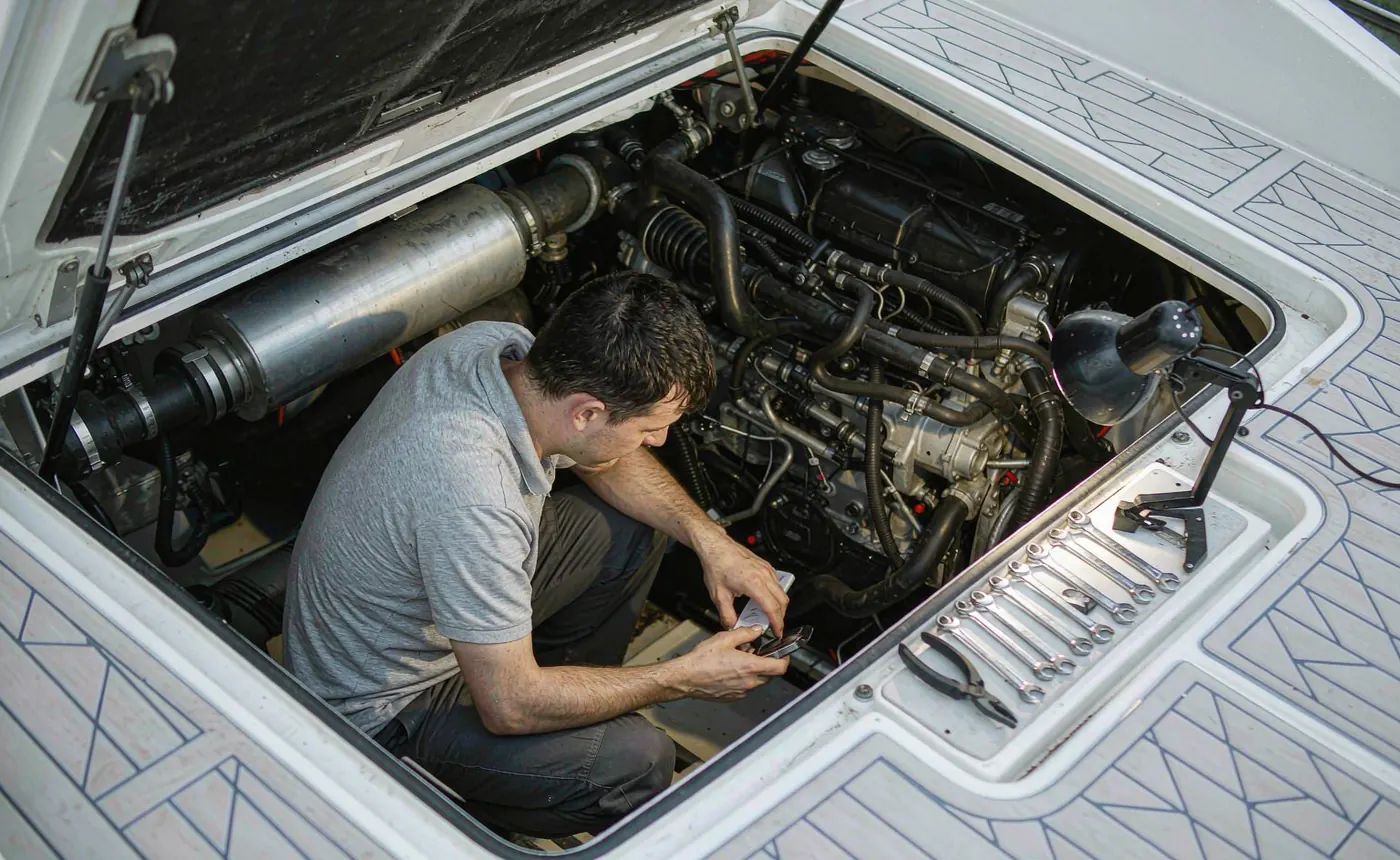
Work the four systems in order
Diesel engines need three things to run — clean fuel, clean air, and compression — plus cooling and electrics to keep running. When something goes wrong, resist the urge to start with the most dramatic explanation. Work down this list and you will find the fault in the large majority of cases:
- Fuel supply. Check the primary filter bowl for water and debris, and the vacuum gauge if one is fitted. This alone accounts for most breakdown call-outs.
- Cooling. Look overboard: is there a steady pulse of water from the exhaust? No water means a strainer, impeller or intake problem, not necessarily an engine problem.
- Air. A blocked deck vent or a saturated air filter chokes the engine slowly — it shows up as low power and black smoke under load.
- Electrics. Loose battery terminals and corroded earth straps cause more "failed starters" than failed starters do.
Shut the engine down at the alarm, find the fault at anchor, and most of these become an hour's work instead of a tow bill. Our engine maintenance guide covers the servicing side of the same systems.
Fuel: where most failures start
Diesel fuel picked up in marinas and from barge deliveries commonly carries water, algae sludge and tank debris. The engine's defences are two filter stages: a primary filter/water separator (a Racor or similar turbine unit), and the engine-mounted secondary filter. Get the micron ratings right and most contamination never reaches the injectors:
| Stage | Typical rating | Why |
|---|---|---|
| Primary filter / water separator | 30 micron (10 micron where fuel quality is known good) | Catches water and coarse debris without clogging quickly; Racor and most engine makers recommend 30 micron here — Yanmar, for one, specifies a 30 micron primary on its engines |
| Secondary (engine-mounted) filter | 10 micron on many mechanically governed engines; 2 micron on some modern common-rail engines | Final protection for the injection pump and injectors; follow the engine manufacturer's rating exactly |
The classic mistake is fitting a fine 2 micron element as the primary. It clogs fast on dirty fuel and starves the engine — the failure it was meant to prevent. Change primary elements roughly every 200–300 running hours or annually, drain the collection bowl regularly during the season, and carry spares for both stages.
Symptoms of fuel starvation follow a pattern: the engine reaches cruise RPM fine at first, then loses power under sustained load, hunts, and finally stops. If it restarts after cooling down and dies again under load, think filter, not pump. A vacuum gauge fitted between filter and lift pump gives you weeks of warning — as a rule of thumb, when the reading climbs past roughly 5 inHg above its clean baseline, change the element.
Overheating: follow the raw-water chain
A marine diesel's cooling is a chain: sea inlet → seacock → strainer → impeller pump → heat exchanger → exhaust elbow. When the temperature climbs, work back up the chain in order, because the first two links cause most cases and cost nothing to check:
- Sea strainer. Close the seacock, open the strainer, empty the basket. A plastic bag or a mat of weed after a passage is the single most common cause. Reopen the seacock before restarting — the classic false repair is cleaning the strainer and forgetting this.
- Impeller. With the seacock closed, open the pump cover and check the neoprene vanes. Cracked, glazed or missing vanes mean replacement. Count the vanes: any that broke off have travelled downstream and will block the heat exchanger, so pull its end cap and retrieve every fragment. Replacing the impeller alone and heading back out is the most common way to overheat again within the hour.
- Heat exchanger. Good water flow at the exhaust plus an overheating engine points here. Scale and salt crust the tubes; a workshop descale restores it.
- Exhaust elbow. Carbon builds up in the mixing elbow over the years, restricting flow — a wear item to replace proactively in saltwater boats.
- Thermostat and coolant. A thermostat stuck closed overheats the engine within minutes of a cold start. On the fresh-water side, check the expansion tank level.
Replace the impeller every year or every 100–200 hours — sources differ on the exact interval, but none suggest waiting for failure. An impeller kit typically runs $30–90; a cylinder head overhaul runs to four figures. Inspect the heat exchanger zinc anodes every few months and replace them at about half consumed; a dissolved anode lets corrosion attack the exchanger from inside. Never run the engine dry, even briefly — the impeller depends on water for lubrication.
Won't start: electrics before the starter
A diesel that cranks slowly or not at all is usually an electrical problem, and it costs nothing to prove. Check in this order: battery terminal clamps (tight and clean), the earth strap between engine block and battery negative, and the voltage across the battery while cranking — below roughly 9.5–10 V on a 12 V system during cranking points to a tired battery or a bad connection rather than the starter motor. Corroded connections can mimic every starting symptom there is.
If it cranks briskly but will not fire, come back to fuel: air drawn into the supply line through a loose fitting will let the engine run, then die, then refuse to restart until it is bled. Bleeding most yacht diesels — a Yanmar or a small Volvo Penta, for example — is a hand-primer lever and two bleed screws, a job measured in minutes once you have done it once. If the engine turns over freely with no compression feel and an unusual clatter, stop: that pattern suggests something mechanical, and turning it further makes it worse.
Reading the smoke
Exhaust colour is a fast diagnostic once you know the vocabulary. Some smoke at cold start is normal on many diesels; persistent colour under load is information:
| Colour | What it usually means | First checks |
|---|---|---|
| Black | Unburnt fuel — over-fuelling or starved air | Air filter and deck vent, propeller fouling loading the engine, injector condition |
| White | Unburnt atomised fuel or coolant entering combustion | Cold engine (normal briefly), then injector spray pattern, then head gasket if persistent |
| Blue | Engine oil being burnt | Overfilled sump first (very common), then worn rings or valve guides on higher-hour engines |
The maintenance that prevents nearly all of this
Every fault above has a cheap scheduled version and an expensive unscheduled one. This is the pattern most experienced owners settle on:
| Item | Interval | Typical cost |
|---|---|---|
| Drain primary filter bowl, check for water | Monthly in season | Free |
| Primary filter element | 200–300 hours or annually | roughly $20–60 |
| Raw water impeller + cover gasket | Annually or 100–200 hours | roughly $30–90 |
| Heat exchanger zinc anodes | Inspect every 3–6 months, replace at ~50% | roughly $10–25 |
| Engine oil and filters | Per manufacturer, commonly 100–250 hours | roughly $100–250 in parts |
| Heat exchanger descale | As needed; every few years in salt water | roughly $200–800 |
The full picture of what routine ownership costs, engine included, is in our monthly maintenance checklist. And before a survey or a season of heavy use, the electrical side — batteries, alternator output, earth straps — deserves the same attention; our electrical systems and battery guide covers it.
Frequently asked questions
What causes most yacht diesel breakdowns? Fuel supply — contaminated fuel, water in the bowl, or a clogged element. It is the reason the primary filter is the first thing to check and the last thing to neglect.
How often should the impeller be replaced? Every 12 months or 100–200 running hours is the range most manufacturers and surveyors quote. Carry a spare and a cover gasket; the replacement itself is a twenty-minute job on most installations.
Can I run the engine briefly to reach anchorage when it overheats? Idle only, and only while you prepare an anchor or arrange a tow. Sustained running on an overheating diesel risks a warped head or a seized engine — both are five-figure repairs, against a tow that is usually three figures or less.
Is white smoke on cold start a problem? Briefly, no — many diesels do it. If it persists once warm, it needs investigation: injector spray pattern first, and if it continues, have the engine checked for coolant entering the cylinders.
If you take one habit from this guide, make it this: look at the exhaust outlet every time you start the engine. That one glance confirms the whole raw-water chain is alive, and it is the cheapest engine-room instrument you will ever use. When an engine problem does surface beyond filters and impellers, it should be part of the survey conversation before you buy — our propulsion systems guide explains what to look at, and our survey guide shows how a surveyor prices engine findings into an offer.