Fix three numbers before you buy a single fitting: how many lux each space needs, what colour temperature belongs there, and whether the fixture will see salt water. The payback is easy to state — twelve 20 W halogen downlights pull about 20 A from a 12 V bank, and the same twelve positions in LED pull under 2.5 A. What follows are the working numbers, the dimming mistake that makes new LEDs flicker, and the visibility ranges your navigation lights are legally required to meet.
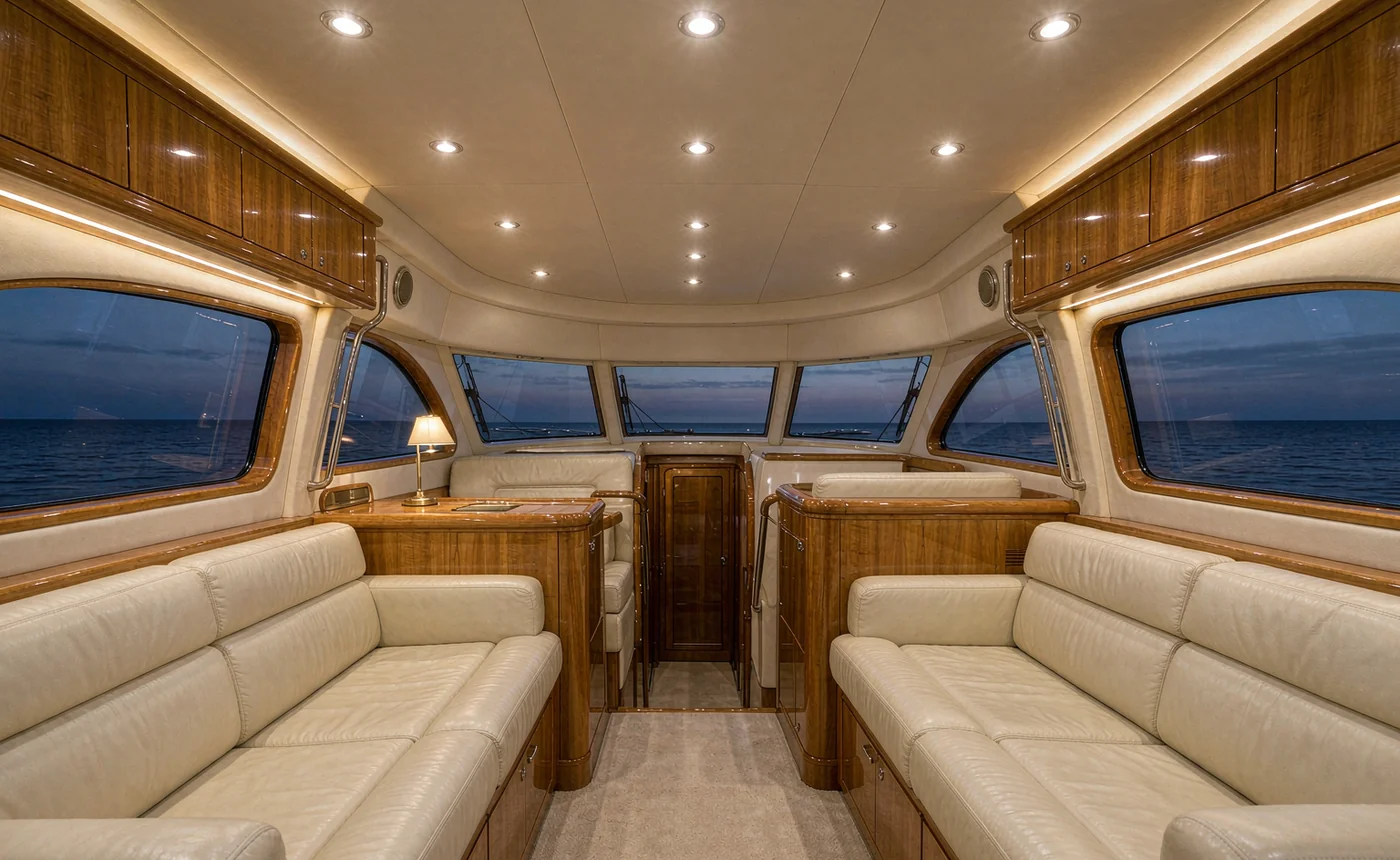
Start with a lux target per zone, not with "bright enough"
Illuminance is measured in lux, and every space on a boat has a different job. Marine and bridge lighting suppliers publish selection tables that turn function into numbers; these are the planning values those tables converge on:
| Zone | Target illuminance | Colour temperature | Minimum IP |
|---|---|---|---|
| Helm / chart table | 300–500 lux by day, deliberately under 50 lux in red night mode | 4000 K white plus a red mode | IP44 |
| Cabins | 100–300 lux general, about 500 lux at a reading position | 2700–3000 K | IP44 |
| Saloon and dining | 200–400 lux | 3000–4000 K | IP54 |
| Companionway and corridors | about 100 lux at floor level, enough to see a step edge | 4000 K | IP54 |
| Galley and heads | about 500 lux on the work surface | 3000–4000 K | IP65 |
| Deck and cockpit work lights | 30–100 lux across the area being worked | 4000–5000 K | IP67 |
Repeat the test after dark. Your eye adapts to whatever light is there, so a cabin can pass a noon walk-through and still be unusable at anchor. Buy one fixture, wire it temporarily where it matters most, and stand where you will actually stand before you order fourteen of them.
Colour temperature and CRI: warm below decks, neutral in the galley, red at the chart table
Kelvin decides how a space feels; the colour rendering index (CRI) decides whether you can tell one thing from another. CRI runs to 100, which is daylight. Aim for 90 or better in living spaces and 85 elsewhere — below that, varnished teak turns grey and galley food looks inedible.
| Space | Kelvin | Why |
|---|---|---|
| Cabins and saloon | 2700–3000 K | Reads as warm against wood veneer and fabric, and is easier on night vision than cool white |
| Galley and heads | 3500–4000 K | Neutral white renders colour honestly, which matters around food, medicine and cleaning |
| Deck and cockpit work | 4000–5000 K | Cooler LEDs convert a watt into more visible light than warm ones — the same phosphor trade-off costs roughly 5–8% of output below 3000 K |
| Engine room | 5000–6500 K | Clarity over comfort in a space you visit with a torch in your teeth |
| Helm and chart table | Dimmable white plus red | Long-wavelength red barely disturbs rod-cell dark adaptation, which is why charting standards build their night palette on low-saturation reds |
The design decision sits one level up from the fixture order, and it is where the boat's interior language is set; the material and layout side of that is covered in our yacht interior design trends guide.
What the halogen-to-LED swap really saves in amps
A 20 W G4 halogen bulb delivers roughly 200 lumens. Current marine LED replacements of the same G4 size hit that output at 1.5–2.4 W, and the smaller 90–150 lumen units replace 10–15 W halogens at 1.4–2.2 W. The saving is not marginal, it is a different order of magnitude:
| Load on a 12 V system | Halogen | LED |
|---|---|---|
| Twelve 200-lumen downlights, lit together | 240 W — about 20 A | 18–29 W — about 1.5–2.4 A |
| Same lights for five evening hours | about 120 Ah drawn from the bank | about 9–12 Ah |
| Rated life | Incandescent boat bulbs rarely exceed 1,000 hours | Marine LED assemblies are commonly rated 25,000–50,000 hours |
Two consequences follow. First, the battery side can shrink, or the same bank can run a longer passage at anchor without the generator — see our electrical systems and battery guide. Second, LEDs care far more about low voltage than filaments do: a halogen at 11 V just looks orange, an LED may flicker or drop out. ABYC E-11 permits 3% voltage drop on navigation lights and other critical circuits and 10% on non-critical ones such as cabin lighting, and marine LED cabin lights visibly dim once the drop passes roughly 5%. At 12 V nominal, 3% is 0.36 V, which is why many marine electricians simply run 10 AWG on lighting circuits:
- Measure at the fixture, not the switch panel, and compare it with battery voltage.
- Check the return path. A long thin negative leg costs as much drop as the positive one.
- Reckon on one gauge thicker than the ampacity table suggests, because on 12 V lighting runs voltage drop sizes the wire, not current rating.
Dimming: use PWM, or expect flicker and colour shift
There are two ways to dim an LED, and only one belongs on a boat. Voltage reduction, inherited from incandescent dimmers, starves the LED of current: the colour shifts (warm whites go warmer, some emitters turn green) and flicker appears at the bottom of the range. Pulse-width modulation, or PWM, switches the LED fully on and off hundreds or thousands of times a second and varies the on-time, so 5% looks the same colour as 100%.
- Confirm the fixture is dimmable at all. It should say so in the specification; dimming a non-dimmable LED damages the driver.
- Confirm the dimmer outputs PWM and check its load rating, including the minimum. Twelve 2 W LEDs may sit below a dimmer's minimum load, which is a common cause of buzzing or a range that jumps from off straight to full.
- Look for a switching frequency above 200 Hz. Quality marine drivers run well above that, in the 1–20 kHz region.
- Verify with a phone camera. Point it at the lit fixture; rolling dark bars mean visible flicker. This is also how you check a fitting someone else installed.
If you are replacing halogens, budget for new dimmers at the same time: the old ones were sized for a 240 W load and now see 25 W. Once the lighting is on a controllable circuit, night and galley scenes are cheap to add — the control side is in our smart yacht technology guide.
IP ratings: match the number to the space
The IP number has two figures: protection against solid objects, then against water. On a boat only the second one changes much, and fitting a domestic fixture in a "dry" cabin is the mistake that ends with a corroded holder two seasons later. Condensation does not respect the word dry.
| Rating | What it survives | Where it belongs |
|---|---|---|
| IP44 | Splashes from any direction | Cabins, saloon, lockers — the acceptable floor for interior work |
| IP54 | Splashes plus limited dust ingress | Companionway, corridors, dining areas |
| IP65 | Water jets from a nozzle | Galley, heads, cockpit, anywhere that gets hosed down |
| IP67 | Temporary immersion, typically 30 minutes at 1 m | Deck and spreader lights, tender lights, exterior fittings |
| IP68 | Continuous immersion to a depth the maker specifies | Underwater lights and hull fittings only |
The housing matters as much as the number: anodised aluminium or 316 stainless bodies, tinned wiring, and a lens seal that can be replaced rather than glued shut — that last point is the difference between a fitting you service and one you throw away. When a unit fails, buy two; colour and output shift between batches, and a mismatched downlight in a saloon ceiling is very visible.
Navigation and anchor lights are a legal specification, not a design choice
This is the part of the lighting plan that has a hard number attached to it. COLREGS Rule 22 sets the minimum range at which each light must be visible, and the ranges depend on the vessel's length overall:
| Vessel length | Masthead light | Sidelights | Sternlight | All-round light |
|---|---|---|---|---|
| Under 12 m | 2 nm | 1 nm | 2 nm | 2 nm |
| 12 m to under 20 m | 3 nm | 2 nm | 2 nm | 2 nm |
| 20 m to under 50 m | 5 nm | 2 nm | 2 nm | 2 nm |
| 50 m and over | 6 nm | 3 nm | 3 nm | 3 nm |
An LED unit has to be certified to produce that intensity across the full horizontal arc of the light — 112.5° for a sidelight, 135° for a sternlight, 225° for a masthead light, 360° for an all-round light. Colour alone means nothing:
- Check the certification on the fixture, not the marketing. "LED navigation light" in a listing is not the same as a unit approved to the required range.
- Check the arcs are not blocked. A pulpit, stack pack, bowsprit net or dinghy on the foredeck can mask a sidelight for the few degrees that matter; sight along each arc from outside the boat.
- Check the vertical placement. Sidelights must sit above the sheer line and clear of the bow wave; the masthead light must be above the cabin structure.
- Keep deck and spreader lights off underway at night, and switch the sidelights off at anchor. A vessel showing sidelights is saying it is underway.
Night discipline is a habit as much as an installation, and it is covered in our night sailing and navigation guide.
Deck, cockpit and underwater lighting: what survives the first season
Nearly every exterior lighting failure traces back to the cable entry, not the LED: salt water wicks into an unsealed gland, eats the terminals within a couple of seasons, and leaves the light itself perfectly good.
- Seal the cable entry with a gland or sealed junction box, mounted as high as the run allows, and leave a drip loop so water runs off instead of down the cable.
- Keep deck work lighting as a work light. 4000–5000 K at 100 lux is a setting for picking up a mooring; left on as ambient light it destroys everyone's dark adaptation for twenty minutes. Courtesy lights stay dim and warm, or red.
- Underwater lights live or die on the hull penetration. Choose units serviceable from inside, or a diver-accessible housing with a replaceable lens seal, and check the through-hull is properly backed and bonded.
If the lighting is part of a wider programme, sequence it with the joinery: cables, conduit and dimmer feeds go in before the ceilings close. That ordering is set out in our refit and renovation guide.
Frequently asked questions
How many lumens does a cabin need? Plan on roughly 100–150 lumens per square metre of floor area for general light, then put a separate directional fitting over the reading position; a 20 W G4 halogen is about 200 lumens, so two or three of those serve a normal double cabin. Test at night, not at midday.
Why do new LED lights flicker or buzz? Usually one of three things: the fixture is not dimmable, the dimmer reduces voltage instead of switching power, or the load is now below the dimmer's minimum because twelve 20 W halogens became twelve 2 W LEDs. Fit a PWM dimmer rated for the new load, then check with a phone camera.
Do LED navigation lights need type approval? Yes. The fixture must be certified to deliver the COLREGS visibility range for your vessel length, and it must be mounted so the required arcs are unobstructed. Colour and apparent brightness are not evidence of compliance.
If you are buying rather than upgrading, the lighting is a shortcut into the state of the electrical system. Matched, correctly aimed fittings, sealed glands on the deck lights and a documented dimmer setup suggest a boat that has been looked after. Four different warm-white shades and unsealed holes in the hardtop are a fair warning for the survey.