Inside the EU, a dog needs three things to cruise: a microchip, a current rabies vaccination and a European pet passport. What catches owners out is the itinerary — touching an unlisted country such as Turkey means a rabies titre test and a three-month wait before you can return. Here is what the rules require, island by island in the Caribbean, and what has to change on the boat.
The paperwork that decides your itinerary
EU pet travel is a non-commercial movement of no more than five animals per vehicle, and there are two documents, not one. An EU pet passport is issued to owners resident in the EU and covers movement between member states; an EU animal health certificate is what you need when arriving from outside, and it is issued per trip.
| Situation | What the animal needs | Timing |
|---|---|---|
| EU to EU, and to or from Switzerland, Norway, Iceland, Monaco or Gibraltar | Microchip, rabies vaccination, EU pet passport | Vaccination valid 21 days after the primary dose; passport valid for life while the vaccine stays in date |
| Into the EU from a listed country | Microchip, rabies vaccination, EU animal health certificate, non-commercial declaration | Certificate issued within 10 days of arrival; by sea, that 10 days extends by the duration of the sea journey |
| Into the EU from an unlisted country — Turkey and Albania, for example | The above plus a rabies antibody titre test at an EU-approved laboratory, result at least 0.5 IU/ml | Blood sample at least 30 days after the primary vaccination, then a three-month wait before entry |
| Dogs only — Finland, Ireland, Malta, Norway, Northern Ireland | Tapeworm treatment against Echinococcus multilocularis with an approved praziquantel product, certified by the vet | Not more than 120 hours and not less than 24 hours before scheduled entry |
Two rules are easy to miss. The animal must enter through a designated travellers' point of entry and the owner has to report to the authority there for checks — an unattended marina arrival does not satisfy that. And the microchip must be implanted before, or on the same day as, the rabies vaccination, or the vaccination counts as invalid.
Why the three-month rule derails Mediterranean plans
Owners assume the vaccination is the hard part. It is not. From an unlisted country the calendar runs: microchip, rabies vaccination at 12 weeks or older, a blood sample at least 30 days later, then three months from the day the sample was drawn. In practice the animal cannot enter until it is roughly seven months old, and a booster missed by even a day restarts the series as a primary vaccination.
- Work out whether your route touches an unlisted country. Turkey is the obvious one for yachts, and so is Albania. Montenegro is treated differently — check the current annexes rather than assuming neighbours match.
- Have the blood drawn and processed early, in the off-season. A satisfactory result does not need repeating while the vaccination stays in date.
- Count the three months from the blood draw, not the vaccination. It is the most common error and cannot be corrected at a border.
- Get the certificate as close to the crossing as the 10-day window allows, remembering that sea travel extends the window.
- Carry the originals. Chip number, vaccination record, laboratory report and certificate must agree on names and dates.
If your cruising is genuinely Mediterranean, the EU side of it is straightforward and a pet passport covers most of it — the cruising ground itself is described in our Mediterranean destinations guide. The complication is always the non-EU hop.
The Caribbean is a different rulebook, and it is per island
There is no regional equivalent of the pet passport. Every island sets its own import rules, and several require a permit applied for weeks in advance. These are the practical differences that shape a winter itinerary:
| Destination | What is required |
|---|---|
| US Virgin Islands | The easiest entry in the region: a health certificate from an accredited vet within 10 days of arrival and a territory import permit, with no foreign customs process |
| Bahamas | Import permit from the agriculture authority, applied for well in advance and valid for one entry, plus a health certificate issued shortly before travel; inexpensive, and no rabies titre for dogs from the United States |
| Antigua & Barbuda | Import licence, plus breed-specific conditions |
| British Virgin Islands | Import permit, a rabies antibody titre, and an ISO microchip on every document |
| Cayman Islands | Rabies titre of at least 0.5 IU/ml, ISO microchip, breed restrictions |
| St Lucia | Rabies titre plus a three-month gap between blood draw and arrival |
| Jamaica | 180 days from rabies vaccination before entry |
| St Vincent & the Grenadines | Long quarantine for dogs from the United States unless residency conditions are met |
Two consequences follow. The treaty that gets you into the EU does nothing here, so a Caribbean season with a dog means permits rather than passports. And only a small minority of the crewed charter fleet accepts pets — a common industry estimate puts it at roughly 5–10% of boats, usually motor yachts with frequent stops. If you are chartering, get the animal confirmed in writing before paying a deposit. The cruising ground is covered in our Caribbean destinations guide.
On board: the changes that prevent accidents
Most pet injuries on yachts happen in the two minutes around a docking or a squall, which is exactly when nobody is watching the animal. Four things fix most of it:
- Grip, not gloss. Varnished teak and polished gelcoat are ice for paws. Non-slip matting on the companionway steps, at the boarding point and along the side deck is the highest-value purchase here.
- A harness, never a collar, plus a fixed tether point. A clipped line inside the cockpit keeps the animal off the side deck during manoeuvring; a collar gives you nothing to grab.
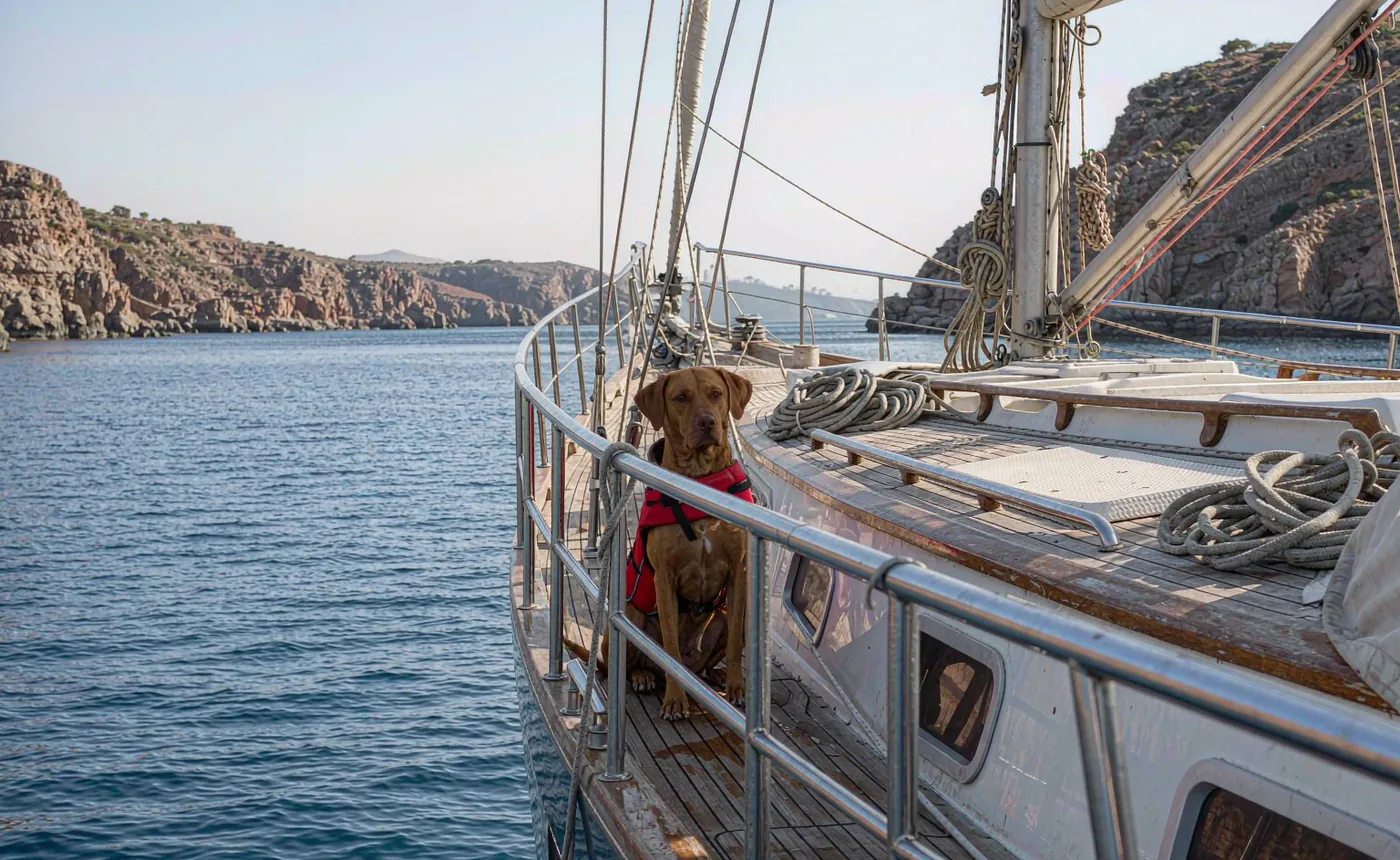
- A flotation harness with a lifting handle, tested in the water. Dogs swim, but they tire against a hull and a ladder they cannot climb.
- A designated relief area, taught ashore first. Matting on the foredeck or swim platform, introduced on land, beats persuading a dog at sea.
Brief the whole crew on one point: in a man-overboard drill a person is assigned to the animal, and it is not the person on the helm. Family crews that already run a briefing routine adapt this easily — the structure is in our family yachting guide.
Heat, motion and the vet question
Dogs do not sweat efficiently, and on a Mediterranean summer cruise the deck runs hotter than the air while a cabin without air conditioning holds heat long after sunset. Shade, airflow and timing beat any gadget: exercise early or late, keep water available constantly, never leave an animal in a closed cabin, and give it a ventilated berth of its own rather than a fixed bimini that stops shading the deck after noon.
Motion sickness affects some animals on their first passages, and it is a veterinary question rather than an internet one — products and doses differ, and human medication is not a substitute. Ask your vet before departure and carry what you are told to carry. It also pays to identify a vet before you need one: marinas usually keep an English-speaking clinic on their list, and a policy that covers travelling pets removes the worst-case decision. General routines at sea are in our health and wellness on board guide.
Shore access: where a dog can actually go
This is the constraint that decides itineraries, and it varies enormously within a few hundred miles. Northern European coasts are broadly permissive. In the Mediterranean, Spanish, Italian and Greek beaches often prohibit dogs outright in high season, while France and Croatia are more relaxed and both have designated dog beaches. Marine protected areas commonly ban animals from trails and beaches alike, ruling out the anchorages that make the cruising good. A cat travels under the same rules but is not covered by the tapeworm treatment, which applies to dogs only.
- Plan two shore visits a day, morning and evening, and anchor accordingly rather than moving on at 14:00 with the animal still waiting.
- Check the beach rule before building the day around it. Ask at the marina office, or check the local authority's own notice; guidebook listings go stale.
- Rinse salt and sand off after every landing, and keep a fresh-water bowl on the dock rather than on the boat.
- Build in one marina stop a week for a real walk and a laundry. Long-term liveaboard routines assume that rhythm — our liveaboard lifestyle guide covers it in more detail.
What it costs, and what to pack
Paperwork costs are modest next to the risk of getting it wrong: a non-compliant arrival can mean the animal is returned or held in quarantine at the owner's expense. Expect a one-off fee for the passport or a per-trip charge for the certificate, a laboratory fee for a titre test, and a small permit fee for Caribbean islands.
| Item | Note |
|---|---|
| Microchip and rabies vaccination | One-off for the chip; the vaccination is an annual or multi-year cost that must never lapse |
| Pet passport or health certificate | Issued by an authorised vet; the certificate is per trip and time-limited |
| Rabies titre test | Only from unlisted countries; the result lasts while the vaccination series stays unbroken |
| Tapeworm treatment | Dogs only, vet-administered, for Finland, Ireland, Malta, Norway and Northern Ireland |
| Caribbean import permit | Inexpensive for the Bahamas, slightly more in the USVI, but applied for weeks ahead |
- Documents: originals in a waterproof folder, plus photographs of every page on your phone.
- Gear: harness with tether, flotation harness with handle, non-slip matting, relief-area matting, bowls that do not slide.
- Health: vaccination record, prescribed medication in original packaging, a spare lead, a basic kit for paws and ears.
Frequently asked questions
Can we take the dog from the UK to the EU on our own boat? Owners resident in Great Britain cannot use a European pet passport for that crossing; you need an animal health certificate issued shortly before travel, valid for 10 days for entry, then for onward travel inside the EU and for re-entry to Great Britain. The dog must be microchipped with a current rabies vaccination, and dogs returning to Great Britain normally need a tapeworm treatment 24 to 120 hours beforehand.
When do we need the rabies titre test? Whenever you enter the EU from a country that is not on the EU's listed annexes — Turkey and Albania are the usual ones on a Mediterranean circuit. The sample is taken at least 30 days after the primary vaccination, the result must be at least 0.5 IU/ml from an approved laboratory, and entry is barred for three months after the draw.
Does a cat need anything different? Cats follow the same microchip and vaccination rules and can travel on the same passport, but the Echinococcus tapeworm requirement applies to dogs only. On board, plan a secured litter tray in a heads or shower compartment and a screen on the companionway hatch.
If you are weighing up a pet-friendly boat, say so early. It changes the shortlist more than most buyers expect: a protected cockpit, easy boarding from the swim platform, shade that actually covers a deck and a cabin the animal can be closed into safely are worth more than another half metre of length.