Seakeeping is easier to judge before you own the boat than after. Three published numbers describe how a hull behaves once the sea gets up — comfort ratio, capsize screening formula and ISO design category — and all three come from the builder, the class association or the broker. Here is how to read them, what heavy weather does to passage time and fuel, and what to do when it arrives anyway.
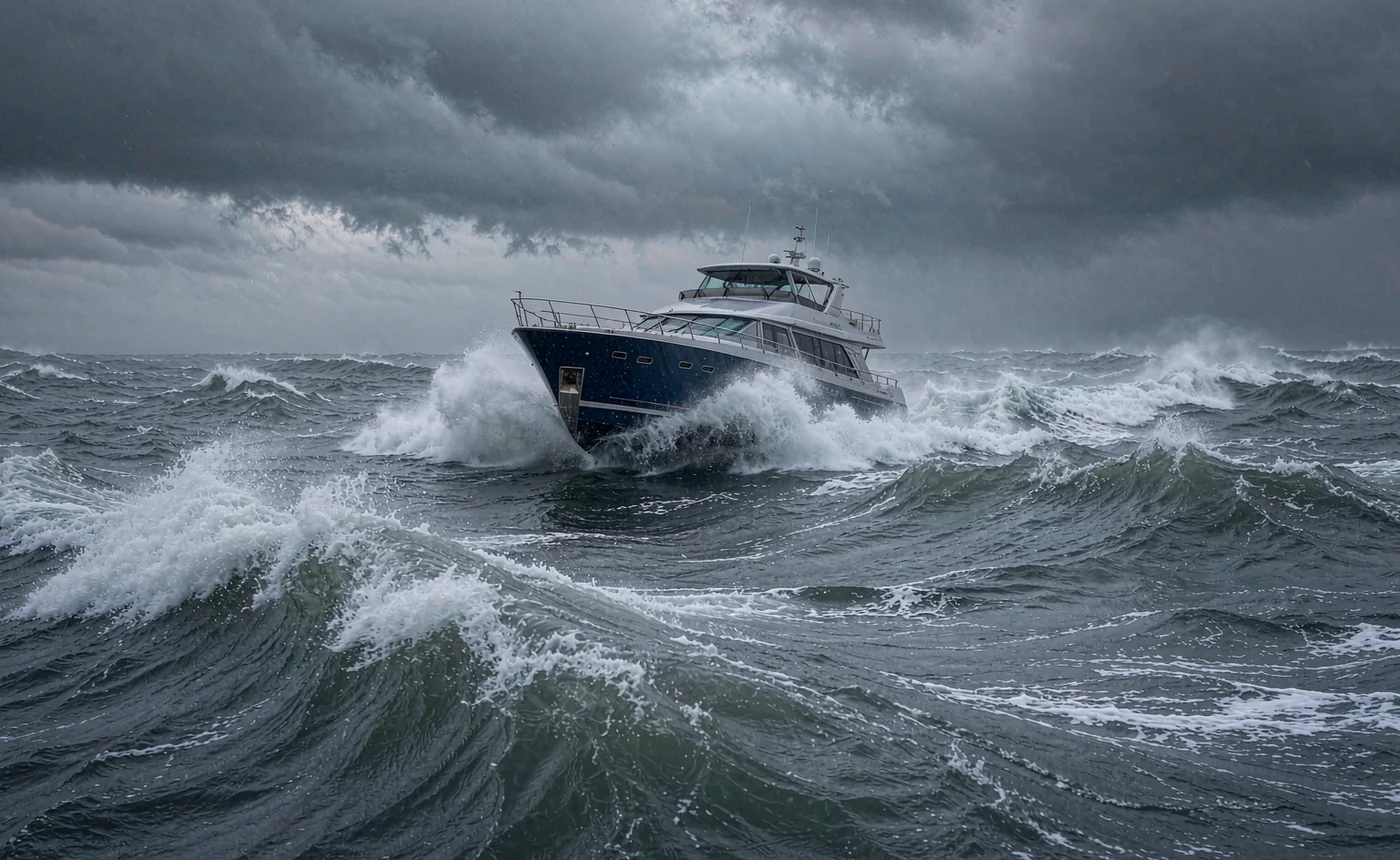
Three numbers that describe how a hull behaves in a seaway
Comfort ratio is the one to learn first. It divides displacement by a length-and-beam term: displacement ÷ (0.65 × (0.7 × LWL + 0.3 × LOA) × beam^1.33), in pounds and feet. Ted Brewer published it in 1979 as a motion-comfort index and was clear it is not a stability calculation. What it does capture is the period of the boat's roll and pitch — heavier, longer and narrower hulls move more slowly through a wave and pass less acceleration aboard.
| Comfort ratio | Motion | Typical boats |
|---|---|---|
| Under 20 | Short, sharp roll and pitch; tiring within hours | Racer-cruisers, sport boats |
| 20–30 | Coastal cruiser; fine in a chop, wearing over 300 miles | Production coastal cruisers |
| 30–40 | Moderate bluewater; where most passage designs sit | Displacement cruising yachts |
| 40–50 | Heavy bluewater; long, slow roll, low acceleration | Heavy displacement voyagers |
| Over 50 | Extremely heavy; comfort paid for in speed and fuel | Steel and expedition hulls |
The capsize screening formula is blunter: beam divided by the cube root of displacement in cubic feet (pounds ÷ 64). A score of 2.0 or less is the accepted marker of a hull suited to ocean passages, and lower is better.
The third number is the boat's design category. ISO 12217-2 sorts hulls into four categories by the conditions they were assessed for, and pairs each with a minimum stability index (STIX) and a minimum angle of vanishing stability (AVS) — the heel angle beyond which the boat will not come back. Every new boat sold in the EU since 1998 has had to be assessed for these values by a notified body.
| Category | Wind | Significant wave height | Min STIX | Min AVS |
|---|---|---|---|---|
| A — ocean | up to Beaufort 10 | about 7 m | 32 | 130° − 0.002 × mass in kg, never below 100° |
| B — offshore | up to Beaufort 8 | about 4 m | 23 | 130° − 0.005 × mass, never below 95° |
| C — coastal | up to Beaufort 6 | about 2 m | 14 | 90° |
| D — sheltered | up to Beaufort 4 | 0.5 m maximum | 5 | 75° |
Two cautions. The category describes the boat, not the crew or the gear. And the figures are calculated at a stated displacement, so a hull that qualifies for Category A in light ship condition can fall short loaded with full tanks and a season's spares. Ask which load case the certificate used.
What a forecast of three metres actually means
Forecasts quote significant wave height: the average of the highest third of the waves in a sea state, not the biggest wave you will meet. Individual heights follow a Rayleigh distribution: about one wave in a hundred is at least 1.5 times the significant height, and one in a thousand reaches roughly 1.86 times it. NOAA's guidance is that the largest wave in a storm is about twice the significant height. A three-metre forecast therefore means four and a half metres in an afternoon, and nearer six if you stay out long enough.
| Beaufort | Wind | Probable wave height | Probable maximum |
|---|---|---|---|
| 5 — fresh breeze | 17–21 kn | 2.0 m | 2.5 m |
| 6 — strong breeze | 22–27 kn | 3.0 m | 4.0 m |
| 7 — near gale | 28–33 kn | 4.0 m | 5.5 m |
| 8 — gale | 34–40 kn | 5.5 m | 7.5 m |
| 9 — severe gale | 41–47 kn | 7.0 m | 10.0 m |
Depth changes what a wave does, which is why one forecast can be uncomfortable in one place and dangerous in another. A wave breaks when the water is shallower than about 1.3 times its height, so a four-metre sea breaks in five metres of water. The bar at a harbour entrance, or the bank across the middle of an open bay, is where a passage turns ugly — and the forecast either side of it will not warn you.
Why two boats of the same length feel completely different
Length is the least useful thing to compare. Displacement, waterline and beam decide the motion, which is what the comfort ratio is measuring: beam sharpens roll acceleration, displacement absorbs it. Period matters more than angle for how fast a crew tires — a slow 20-degree roll is easier to live with than a fast 12-degree snap.
You can also change how much motion you feel without changing the boat. Roll is driven by the relationship between the hull's own roll period and the period of the waves arriving from the side, and speed and heading both shift it. In practice a 10-degree course change, or five knots either way, is often enough to stop a boat working through a beam sea — and it costs nothing but distance.
Stabilisation is the paid version of the same idea. Fin stabilisers work only with way on the boat; gyro stabilisers work at anchor and underway; Magnus-effect rotors sit between the two. In a beam sea at rest, the difference a running gyro makes is the difference between a usable saloon and an unusable one.
Multihulls need a separate frame of reference. A catamaran scores a low comfort ratio because it is light and wide, yet most owners report far less motion at anchor than a monohull of the same length; the trade shows up in a steep, short sea. What that means over distance is set out in the bluewater cruising guide.
What heavy weather costs in time and fuel
The money is not in the storm, it is in the days around it. Work the arithmetic before you leave and the decision stops being a question of nerve.
- Build the window, not the departure date. Look for the spell in which wind and sea stay inside your own limits for the whole passage — the method is set out in our weather and passage-planning guide.
- Convert the forecast into a speed you can hold. In a head sea that means the speed at which the bow stops leaving the water; on a 20-metre hull it is often 8–10 knots where the brochure claims 22.
- Apply the cube law. Below hull speed the power a displacement hull needs rises roughly with the cube of its speed, so 10 knots down to 7 cuts fuel burn by about two-thirds and adds 40% to passage time: 600 miles is 60 hours at 10 knots, 86 at 7.
- Cost the arrival, not just the crossing. Berths, agent fees and crew hours move with you, and the marina that had space on Tuesday may not on Thursday.
- Write the call down before you need it: at what forecast, at what hour, you wait or turn back. That decision is easier from a dock than from a wheelhouse.
What to check at survey and sea trial
- Find the design category on the builder's plate or the original CE certificate. If the boat was sold outside Europe, ask for the designer's declaration.
- Ask for STIX and AVS in writing. Class associations, the RORC/IRC published lists and the builder's stability booklet all carry them; a hull with no figures cannot be compared.
- Establish the load case. Figures taken at light displacement and figures taken loaded can land in different categories, and gear, spares and full tanks are what push a boat over the line.
- Sea-try it in 20–25 knots, not in a flat calm. Two hours upwind in a short chop teaches you more about motion, noise and stowage than any specification sheet.
- Walk the boat as if it were blowing. A sea berth with a lee cloth, a handhold within reach of every standing position, deadlights or storm shutters, somewhere to lash the tender, and galley lockers that stay shut when the boat heels.
Four tactics for when it arrives anyway
The right answer depends on the hull, the sea state and how tired the crew is.
| Tactic | What it does | Use it when |
|---|---|---|
| Heave to | Stops the boat, holds it about 50° off the wind, drift near a knot | Moderate gale, sea room to leeward, a crew that needs rest |
| Forereach | Keeps steerage and way on, riding the seas instead of taking them beam-on | Light modern hulls that will not lie quietly when hove to |
| Run off under bare poles with a drogue | Puts the stern to the seas and limits speed to about 2–3 knots | Breaking crests and survival conditions |
| Sea anchor on the bow | Holds the bow to the seas, near-zero drift | Fetch-limited, well-organised waves — not confused seas |
If you carry a drogue, read the sizing table before you buy. A Jordan series drogue for a 10,000 lb boat is 100 cones on 167 ft of line; 20,000 lb takes 116 cones and 25,000 lb takes 124, with the line tapering towards the tail. Two rules come with it: the bridle legs should be about 2.5 times the transom width, and the drogue is never deployed from the bow. The attachment points must take the load — padeyes or chainplates with backing plates, not standard mooring cleats. Check them alongside the rest of the rigging and deck hardware at survey.
What the kit costs
| Item | What it does | Typical price, 2026 |
|---|---|---|
| Storm jib, 8–9 oz Dacron | Balance forward when the headsail is too much sail | about $600–1,400 |
| Trysail on its own track | A storm mainsail that does not need the boom or the mainsail | about $1,200–3,000 |
| Jordan series drogue, sized by displacement | Limits speed and holds the stern to the seas | about $800–1,800 |
| Reinforced drogue attachment points | Makes the drogue usable at all | a fabrication job — get the quote first |
Two of these need a decision before the money is spent. A trysail needs a track installed for it, and a drogue needs somewhere on the transom strong enough to hang the boat from — buy either without the hardware and you have bought nothing.
Frequently asked questions
Is a Category A boat automatically safe in heavy weather? No. The category states the conditions the hull was designed and assessed for, at a particular displacement. Age, loading, maintenance and crew experience all move the real limit, and a well-found Category B boat in careful hands is usually safer than a neglected Category A one.
Do I need a drogue on a motor yacht? If it is a displacement hull, yes. Running off in a big following sea works the same way under power as under sail, and a drogue is what stops the boat surfing and broaching. Drogues are common on bluewater sailing yachts and rare on motor yachts that never leave the coast — a gap worth closing before a long delivery.
Where should the plan live? On the boat, in writing, with the tactics and the trigger conditions the skipper will actually use. The planning side of it — routes, weather windows and the decision points between them — is covered in our storm planning guide.
If you are shopping, ask for the comfort ratio, the capsize screening formula and the design category before you ask the price. They are the start of the conversation, not the end of it — the rest is seamanship, and that is not in the brochure.