Size the heat load before you pick a brand. A shaded below-deck sleeping cabin needs about 10–12 BTU per cubic foot of space, a typical main cabin around 14, and a glass-heavy pilothouse 16–19. Get that number wrong in either direction and the boat is either unbearable in August or short-cycling itself to death. This guide covers the three system types, what the hardware cost in 2026, the seawater side that half the installs get wrong, and the fault-finding order that resolves most "it stopped cooling" calls.
Size the load in BTU per cubic foot, not per boat
Cooling capacity is measured in BTU per hour; one "ton" is 12,000 BTU/h. The honest way to size a marine system is a room-by-room calculation, because a boat is a box of glass and metal floating on a mirror: below-deck cabins are shaded and cooler, while pilothouses act like greenhouses. Manufacturer sizing guidance in the trade puts the ballpark like this:
| Space | Rule of thumb | Rough equivalent |
|---|---|---|
| Below-deck stateroom, used mainly at night | 10–12 BTU per cubic foot | about 60 BTU per sq ft |
| Typical main cabin or saloon, mixed glazing | about 14 BTU per cubic foot | about 90 BTU per sq ft |
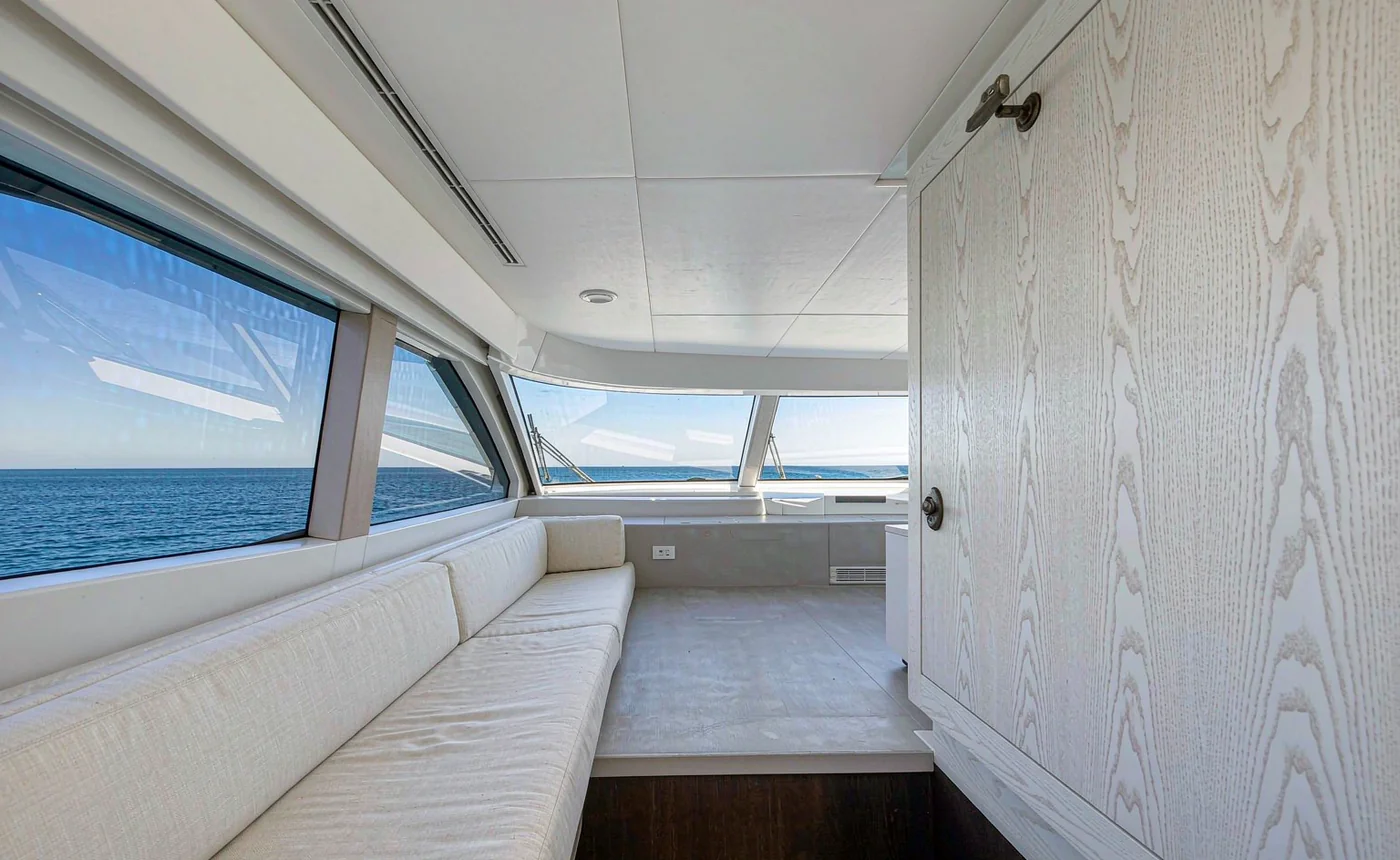
| Pilothouse or helm area, large windows, full sun | 16–19 BTU per cubic foot | about 120 BTU per sq ft |
Worked example: a saloon 12 ft long, 12 ft wide and 6.5 ft high is about 936 cubic feet. At 14 BTU/ft³ that is 13,100 BTU — the point where most owners step up to a 16,000 BTU unit. Add roughly 400–600 BTU/h per person on board, and more for tropical operation. Do not oversize: an oversized unit satisfies the thermostat in a few minutes, then switches off before it has pulled any moisture out of the air, so the cabin turns cold and clammy and the compressor wears out on starts.
The three system types, and the boat length each one fits
All seawater-cooled systems move heat from cabin air into refrigerant, then into the sea. They differ in where the compressor lives:
| Type | Where the compressor sits | Best fit | Trade-off |
|---|---|---|---|
| Self-contained (DX) | Inside the cabin unit, under a berth or settee | Boats under about 40 ft (12 m) | Cheapest and simplest; the compressor is audible where you sleep |
| Split-gas (DX) | Condensing unit in the engine room, air handlers in cabins | Up to about 80 ft (24 m); refrigerant lines max about 50 ft | Quiet cabins; needs a certified technician to charge the circuit |
| Chilled water | Chiller in the engine room cools a fresh-water loop | Over about 80 ft (24 m), any number of air handlers | Smooth load management and no line-length limit; highest install cost |
Two smaller variants matter on sailing boats: 12/24 V DC units run straight off the house bank with no generator, at roughly double the price of an AC unit, and air-cooled units avoid the seawater circuit entirely but need hull or deck vents and lose capacity in hot engine spaces. Which electrical side you are on — shore power, generator or lithium bank — is decided before you choose a unit, and our electrical systems and battery guide covers that wiring.
What the hardware costs in 2026
Equipment prices are stable enough to plan against. Installation is where quotes diverge, because ducting runs, hull penetrations and cabinet work dominate the labour.
| Item | Typical 2026 equipment price | Note |
|---|---|---|
| Compact self-contained, 6,000 BTU | about $1,200 | V-berth or small day boat |
| Self-contained, 16,000 BTU | $1,800–2,200 | The workhorse size for a 30–40 ft saloon |
| Split system condensing unit, 24,000 BTU | about $5,500 | 45–65 ft, plus air handlers |
| DC self-contained, 16,000 BTU (12/24 V) | about $5,000 | Runs off lithium banks, no generator |
| Chiller unit, 50,000 BTU class | from about £10,800 (UK list) | Plus £1,000–3,400 per fan coil in each cabin |
For a single-zone seawater-cooled retrofit, installers often quote an all-in planning figure around $5,000 including the unit, pump, ducting and labour. At the top of the market it is a different order of money: industry estimates place the HVAC plant of a 24–40 m new build at roughly $120,000–280,000, about 4–6% of construction cost. If the air conditioning is going in during a larger project, sequence it with the rest of the work described in our refit and renovation guide — ducting and piping go in before joinery closes everything up.
Seawater is half the system: flow, temperature and materials
Every BTU the unit removes ends up in the sea, so the raw-water circuit matters as much as the refrigerant side. Three rules carry most of the weight:
- Flow: 3–4 gallons per minute per ton. Cruisair's guidance works on about 180 gph per 12,000 BTU; Dometic and the ABYC training material teach 250 gph. A 16,000 BTU unit therefore wants roughly 3 gpm. Undersized pumps and kinked hose show up as poor cooling that gets worse as the water warms.
- Temperature limits. Cooling is designed around seawater below 90°F (32°C). Above that, capacity falls and a high-pressure switch can shut the unit down — the classic "it dies every afternoon in August" complaint. In reverse-cycle heating, full output runs to about 55°F (13°C) seawater, about half capacity at 40°F (4.4°C), and below roughly 38°F (3.3°C) the unit should not run at all, because water can freeze in the condenser coil.
- Materials. The seawater condenser is the part the ocean tries to eat. Standard units use 90/10 cupronickel; titanium costs more and is effectively immune to saltwater corrosion, which is why it is specified on boats that live in warm marinas.
Plumbing should be self-draining, so lifting the boat empties the circuit — that is what prevents air locks. Centrifugal pumps are not self-priming and must sit below the waterline. If several units share one pump, the circuit also needs a pump relay and manifold. The seawater side is exactly where the galley refrigeration and air-conditioning worlds overlap; the power-draw logic in our marine refrigeration guide applies here too.
When it stops cooling, work the chain in order
Nine out of ten service calls end in one of the first three steps. Work down the list and verify each item before moving on:
- Water flow. Open the seacock, clean the strainer, look for a steady discharge stream overboard. No stream: check the pump impeller, which is a 30-minute wear item. A partly blocked strainer mimics every high-pressure symptom.
- Airflow. Pull the return-air filter and hold it up to a light. A grey filter quietly cuts capacity for weeks before anyone notices. Confirm the discharge grilles are open and the ducting has not collapsed.
- Water temperature. Read the seawater temperature. Above 90°F you are at the design limit; the system is not faulty, it is short.
- Refrigerant. Oily residue at a fitting or a coil that ices over points to a charge loss. Charging is a certified-technician job — current units run R-410A, and the older R-22 circuits are gone from new equipment.
- Electrics and compressor. Check the breaker, the connector at the control head, and voltage at the compressor start. Low shore-power voltage trips units that are otherwise healthy.
What it costs to run
A 16,000 BTU seawater-cooled unit draws roughly 14 amps at 115 V or about 7 amps at 230 V — call it 1.5 kW with the compressor running, so a summer day at anchor costs something in the region of 10–14 kWh once cycling is included. On shore power that is trivial. On a generator it is not just fuel: a unit this size may be the only significant load, which parks the genset in the low-load regime where diesels glaze and soot. Pair the air-conditioning load with other consumers, or pick the generator size against a real load list rather than a guess — the sizing method is in our marine generator selection guide. DC units avoid that problem entirely, which is why lithium-equipped cruising boats increasingly run cooling straight off the bank; for automation and remote monitoring of temperatures and faults, see our smart yacht technology guide.
The maintenance that keeps it alive
Marine HVAC dies of neglect, not age. Five items, each with its own check:
- Strainer: clean monthly in the cooling season, weekly in weed-filled anchorages.
- Air filter: wash or replace every two to four weeks while in use; hold it to a light to check.
- Condensate drain: confirm the pan drains freely — a blocked drain is the usual cause of a mystery puddle under a berth.
- Seawater circuit: at haul-out, let the self-draining plumbing empty, then flush with fresh water.
- Season-start test: run each zone for 20 minutes before launch week and record supply-air temperature; a falling number year on year is the early warning of a fouled coil.
Frequently asked questions
How many BTU does my cabin need? Cubic feet times the exposure factor: 10–12 BTU/ft³ for shaded below-deck berths, about 14 for a mixed main cabin, 16–19 for a sunny pilothouse. A 936 ft³ saloon lands near 13,000 BTU, which is why 16,000 BTU units sell so well.
Why does the unit shut down on hot afternoons? Seawater above 90°F (32°C) drives refrigerant pressure up until the high-pressure switch trips. Clean the strainer first — a flow restriction produces the identical symptom — then accept that the unit is at its design limit.
Does marine air conditioning also heat? Reverse-cycle units do, using the same circuit in reverse. Expect full output down to about 55°F seawater and roughly half at 40°F (4.4°C); below about 38°F (3.3°C) leave it off so the condenser cannot freeze.
If you are buying rather than retrofitting, make the HVAC plant part of the survey conversation: ask for the unit ages, the refrigerant type and the last service record. A 40-foot boat with three tired 16,000 BTU units is looking at a five-figure replacement that a clean survey record would have priced into the deal.