Size a marine generator from your load list, not from your boat's length. Add up the appliances you will run at the same time, add roughly 20% for starting surges, and pick the rating that keeps the set running at 50–80% of its capacity. On a 45–50 ft cruiser with two air-conditioning zones, a watermaker and a battery charger, that lands between 9 and 15 kW. Undersize it and you trip breakers on a hot afternoon; oversize it and low-load running quietly ruins the engine. Below is how to get the number right, what the hardware costs in 2026, and how to keep a set alive past 5,000 hours.
Start with a load list, not a rule of thumb
The number you need is not how much power the boat could theoretically draw. It is how much it draws at 8 pm on a hot evening with the air conditioning on, dinner cooking and the batteries charging. Write those loads down as running watts, then add a margin for the moment the compressors start.
Air-conditioning compressors are the reason the margin exists. A compressor draws its running watts continuously but pulls roughly two to three times that for a second or two at start-up, which is why two identical boats can need different sizes depending on whether their air-conditioning units stagger their starts.
| Load | Typical running draw | Start-up surge |
|---|---|---|
| Air conditioning, 16,000 BTU | about 1,500 W | about 3,500 W |
| Refrigeration or freezer | 400–800 W | up to roughly 2,000 W |
| Battery charger, 100 A at 12 V | 500–1,500 W | — |
| Watermaker | 800–1,500 W | — |
| Induction hob or kettle | 1,500–2,000 W | — |
| Microwave | 1,000–1,500 W | — |
Those figures are typical for 230 V equipment on European boats; your appliance plate always wins over a table. The charger line is the one owners underestimate: a big charger running flat out after a night at anchor is a load in its own right, and it is the load that decides whether you need 8 kW or 12 kW. How that charger interacts with the battery bank is covered in our yacht electrical systems and battery guide.
What size suits which boat
Once you have the total, match it against the band that boats of your length normally sit in. These are installed sizes, not catalogue maximums:
| Boat | Typical installed generator |
|---|---|
| Sailboat under 35 ft, no air conditioning | 3.5–4.5 kW |
| Cruiser 35–45 ft | 5–8 kW |
| 45 ft and up, two or more air-conditioning zones, watermaker | 8–15 kW |
| 60–100 ft motor yacht, full hotel load | 20 kW and upward, often two sets |
Two smaller sets sometimes beat one large one: run one at a sensible load for house loads, bring the second online for cooking, laundry or a watermaker run. It costs more to buy and maintain, but it removes a single point of failure and avoids running a 20 kW set at 15% load all day. A watermaker is the classic case — a large intermittent load, covered in our watermaker and desalination guide.
Fixed speed or variable speed
Fixed-speed sets run at a constant 1,500 rpm on 50 Hz systems and 1,800 rpm on 60 Hz. That is the traditional marine genset: simple, cheap to repair anywhere, and happy at high load.
Variable-speed sets, usually built around a permanent-magnet alternator, spin between roughly 2,200 and 2,800 rpm and change speed to follow the electrical load. They use less fuel and make less noise when the load is light, and they are markedly smaller for the same output. The trade-off is a higher purchase price and more electronics to go wrong in a hot, damp engine room.
Fuel consumption figures from the manufacturers, measured at 75% load on 50 Hz units:
| Output class | Fuel burn at 75% load |
|---|---|
| 6–12 kVA | about 1.6–2.8 L/h |
| 15–30 kVA | about 3.2–6.5 L/h |
Read those numbers as a best case, because they assume the set is loaded. A 12 kVA unit carrying 3 kW burns nearly the same litres per hour as one carrying 9 kW, so the fuel cost per kilowatt-hour roughly triples. That is the whole argument for sizing honestly instead of carrying a fat margin you never use. Where the generator sits in the wider drive train — beside the main engines, and possibly a hybrid motor — is set out in our yacht propulsion systems guide.
What the hardware costs in 2026
Dealer listings checked in mid-2026 give a useful sense of the market. Treat these as indicative hardware prices in US dollars, not quotes:
| Model | Output | Listed price |
|---|---|---|
| Lombardini LMG4000 | 4 kVA | about $6,900 |
| Fischer Panda 4000s.Neo PMS | 3.4 kW / 4.0 kVA | about $8,100 |
| Fischer Panda 10000i PMS | 8.0 kW / 10.0 kVA | about $18,100 |
| Cummins Onan QD 17.5MDKDR | 17.5 kW | about $22,300 |
| Fischer Panda 15000x PMS | 12.7 kW / 15.0 kVA | about $29,100 |
Two 10 kW sets can differ by several thousand dollars, and it is rarely about the badge. Fixed versus variable speed, single versus three phase, 50 versus 60 Hz, sound enclosure, cooling arrangement and the control panel all move the price. When you compare quotes, compare the list of what is included, not the kW figure. The other brands that come up repeatedly in cruising forums are Northern Lights, Kohler, Phasor and Paguro.
Budget separately for installation. Exhaust routing with a water-lift muffler, the sea-water intake and strainer, fuel supply and return, mounts, sound insulation, panel work and commissioning are quoted as a package, and the total depends more on how hard the engine room is to work in than on the generator you chose. On a refit, lifting the old set out and the new one in is often the largest single line.
Noise, weight and the space nobody budgeted for
Sound figures need context. Sound-shielded sets are commonly quoted at around 52–58 dB(A) measured at 7 metres; open-frame units run 68 dB(A) and above. The difference between those two numbers is the difference between sleeping through the night at anchor and not.
Where the noise comes from tells you where to spend: the enclosure panels, the double-resilient mounts that stop vibration reaching the hull, and the exhaust silencer. A set that is quiet in the workshop can be loud in a boat if it is bolted hard to a bulkhead shared with the aft cabin. Mount it on flexible mounts and route the exhaust away from the sleeping areas.
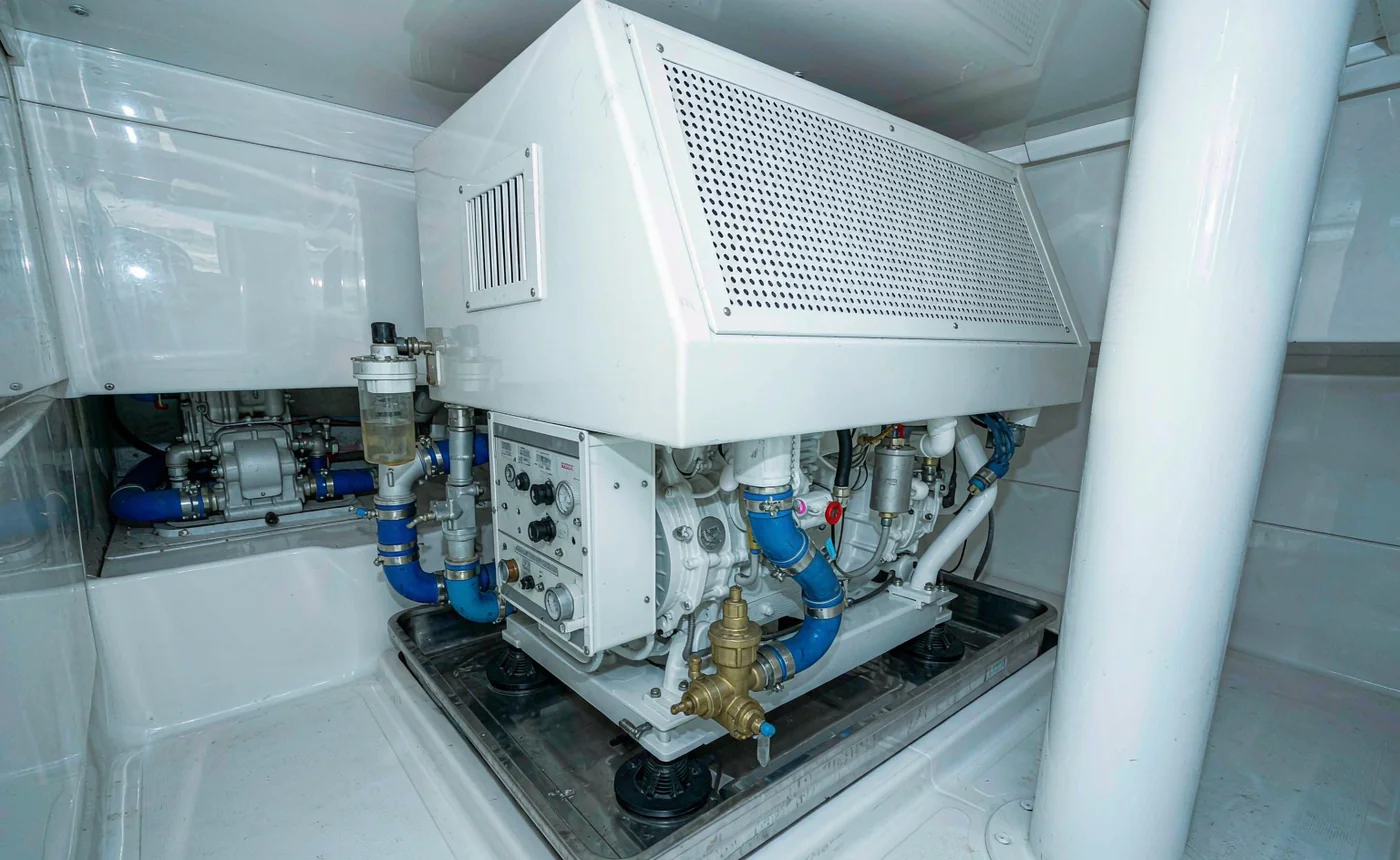
Weight matters for trim and for the lifting gear, and the figure you need from the datasheet is the wet weight with enclosure, not the dry engine weight. Ventilation is the constraint that gets missed: the set needs combustion air and a route for hot air to leave the compartment. Squeeze it into a sealed lazarette and it runs hot, derates and shortens its own life. Whatever the manual states as service clearance, add more — you need to reach the impeller, the fuel filters and the dipstick without dismantling joinery.
Running it well: avoid the low-load trap
The most common way owners destroy a perfectly good generator is by buying too much of it and then never loading it. Here is the routine that keeps a set healthy.
- Size for 50–80% load in normal cruising. That band is where fuel consumption per kWh is lowest and combustion is cleanest.
- Treat anything under 30% as temporary. Below roughly 30% of rated load, cylinder temperature drops, fuel stops burning completely, and unburned diesel and soot accumulate in the exhaust and on injector tips. That is wet stacking, and it is an operational problem, not a manufacturing defect.
- Do not try to fix it with high idle. Running the engine fast with no electrical load does not raise combustion temperature enough to burn off the residue, and it adds wear for nothing.
- Burn it off with real load. Four or more hours near rated load will oxidise soft carbon deposits. If your typical day is light, schedule a long loaded run every few months rather than hoping the problem goes away.
- Watch four symptoms. An oily black film at the exhaust outlet; fuel consumption per kWh creeping up; engine oil level rising between changes, which points to fuel dilution; and progressively longer cranking. Any two together justify a technician and an oil sample.
- Service on hours, not on the calendar alone. Oil and filter changes commonly fall every 150 hours or annually, and the raw-water impeller is an annual item. Carry spare fuel filters. Fuel-system fouling and starting-circuit faults are the two most frequent causes of a genset refusing to start, and both are cheap to prevent. The wider schedule is in our yacht engine maintenance guide.
One more thing on failure modes: a raw-water-cooled set lives or dies on its intake. A blocked strainer or a failed impeller stops cooling within minutes, and the next thing you hear is the overheat alarm. Check the strainer before every start, and never leave the seacock closed by habit.
Diesel, petrol or battery?
| Option | Best for | What it costs you |
|---|---|---|
| Fixed-speed diesel genset | Air conditioning, watermaker, long cruising | Weight, noise, regular service |
| Variable-speed diesel genset | Light but constant loads, night running | Higher purchase price, more electronics |
| Portable petrol set | Tenders, occasional top-up when no set is installed | Separate fuel storage; not ignition-protected for a fuel-confined engine bay |
| Large alternator with a lithium bank | Sailing yachts with modest AC demand | Needs engine hours; limited peak output |
If the boat is already diesel, a diesel genset draws from the main tanks and is the obvious answer. A petrol set belongs on deck or in a dedicated locker, never in an engine room where fuel vapour can collect — that is a fire risk that surveyors and insurers take seriously. The alternator-and-lithium route is genuinely attractive on a sailing yacht with no air conditioning, but it will not carry an induction hob, a watermaker and a charger at once.
Frequently asked questions
What size do I need for a 45 ft yacht? Most 45-footers with air conditioning land between 5 and 8 kW, rising to 8–15 kW once you add a second air-conditioning zone, a watermaker and a big charger. Do the load list first, then compare the total with the bands above.
Is low load really that bad? Yes. Below roughly 30% of rating the engine cannot burn its fuel properly, and the deposits that build up in the exhaust, on injectors and on piston crowns are cumulative. Mild cases clear with a long loaded run; heavier ones need injector service or a top overhaul.
How long should a marine generator last? With oil and filter changes on schedule, clean fuel and regular loaded running, 3,000–5,000 hours is a realistic expectation, and well-kept units exceed 8,000 hours. Neglect the fuel system and the raw-water side and you will be rebuilding it far earlier.
50 Hz or 60 Hz? Match where the boat is based and what the shore power and appliances expect — Europe, most of Asia and Australia run 50 Hz, the United States and Canada 60 Hz. It cannot be corrected after the fact, so settle it before ordering.
Can I sell a used generator with the boat? You can, and a documented service history with hour readings is worth real money at resale. Buyers and surveyors treat an undocumented genset as a risk, which is why our diesel troubleshooting guide starts with the log.
The decision that matters is made before you sign the order: build the load list, add the surge margin, and buy the smallest set that keeps you in the 50–80% band. Everything else — brand, enclosure, variable speed — is detail you can argue about afterwards. If you are buying a boat with an existing generator, insist on an hour meter reading and a service file, and expect to replace the impeller and all filters before your first long trip.