Most anchoring bans in the Mediterranean protect a single plant: Posidonia oceanica, the seagrass that carpets the shallows from the Balearics to the Aegean. France has banned yachts over 24 metres from anchoring on its meadows since 2019, with fines up to €150,000 — and courts have already collected €90,000 from one captain, plus a three-year sailing ban. The Balearics go further: since 2018 anchoring on Posidonia is illegal for every boat, whatever its size or flag. The fix is cheap — check a seabed map before you leave the dock, and put the hook on sand. This page sets out who bans what, what the fines actually look like, and the five-minute check that keeps you clear of all of it.
Why a seagrass meadow has legal teeth
Posidonia is not seaweed but a flowering plant, endemic to the Mediterranean and listed as a priority habitat under the EU Habitats Directive. The meadows store carbon, buffer the coast against storms and nurse most of the fish you see in a marina — and they are shrinking fast: around 30% of the basin's meadows have been lost in recent decades to anchoring, trawling, coastal construction and pollution.
The biology is what makes regulators uncompromising. Meadows grow by roughly a centimetre a year, so one anchor dropped on the grass can destroy more than 100 square metres of meadow in a single morning, and recovery is measured in decades to centuries — the meadow between Ibiza and Formentera, a UNESCO World Heritage site since 1999, is estimated to be up to 100,000 years old. That asymmetry is why several countries now treat anchoring on the grass the way they treat anchoring in a shipping lane.
France: the strictest regime in the basin
France does not hide the ball. Decree 123/2019 of the Préfecture Maritime de la Méditerranée prohibits yachts over 24 metres from anchoring in defined Posidonia zones unless they use a buoy, dynamic positioning or an organised anchorage; seventeen prefectural decrees issued between 2020 and 2023 extended coverage to the entire French Mediterranean coast. Larger boats carry more duties, and France sanctions the vessel's position itself — inspectors do not have to prove the anchor actually touched grass.
| Yacht length (French Med) | Rule over Posidonia zones |
|---|---|
| Over 24 m | Anchoring banned — use buoys, dynamic positioning or organised anchorages only |
| Over 45 m | Must notify the authorities before anchoring or holding in these zones |
| Over 80 m | Official authorisation required in advance |
Penalties reach €150,000, with possible suspension of the navigation licence, a ban from French waters and, for the most serious cases, up to a year of imprisonment. The courts are using the full range. A 26-metre yacht drew a €20,000 fine and a one-year ban; a 51-metre captain paid €15,000 plus more than €22,000 in damages; and in the most severe ruling reported so far, the captain of a 37-metre yacht convicted of anchoring in the Cap Corse–Agriate marine park paid €90,000 and lost the right to sail in French waters for three years. Insurance does not make the problem go away — yachts are often held in port until fines are settled.
The Balearics: banned for every boat, patrolled all summer
Spain's Balearic government banned anchoring on Posidonia in Decree 25/2018, in force since July 2018, and it applies to every vessel regardless of size or nationality. The government publishes official Posidonia cartography with red zones (existing meadows) and yellow zones (potential recovery areas), both closed to anchoring, plus a free app and a dedicated VHF channel that talked more than 6,000 boats onto sand in 2020 alone. In season, roughly twenty patrol boats of the monitoring service work the archipelago.
Enforcement is education-first but not soft. In 2020 about 73,000 vessels were checked and 6,000 were asked to move off the grass; the share of inspected boats found on meadows fell from over 10% in 2022 to 4.2% by October 2023. In 2025, 4,813 boats were detected on protected meadows around Ibiza and Formentera and 18 formal infractions were issued — about one fine per 270 boats. The law's ceiling is the serious part: fines under the regional environment law run from about €100 to €450,000, and the national biodiversity act reaches higher. The practical rule for a Balearics itinerary: plan the day around buoy fields and sand patches, not around the prettiest bay on the chart.
Greece, Italy and Croatia: zoning, not blanket bans
Greece has no national anchoring ban over Posidonia. Protection arrives indirectly, through biodiversity law and marine parks: bottom trawling was banned across the Alonnisos and Northern Sporades national marine park in September 2025, and protected areas such as Gyaros have installed eco-moorings. Inside marine parks and Natura 2000 sites, local rules apply bay by bay — check them the day before, not at the beach.
Italy passed a law in May 2026 that explicitly names Posidonia and forbids damage to it, but attaches no penalties and no implementing decree yet — the constraint that actually bites is the marine protected areas. At Portofino, anchoring is prohibited outright in zones A and B, and mooring inside the area is only at pre-assigned buoys with fees by length. Croatia protects the habitat on paper without a seagrass-specific anchoring rule, but the Kornati national park does the work with zoning: anchoring and overnight stays are allowed only in eighteen named bays, four zones are closed entirely, and entry is ticketed by length — €95 a day for a 17-metre yacht in the 2026 high season, €320 for 34 metres, €1,035 for 74 metres.
Five checks before you drop the hook
- Consult the seabed map before you arrive. Donia for the French coast, Medtrix for habitat layers, and the Balearic government's Posidonia app and cartography in Spanish waters. Thirty seconds of chart time replaces an afternoon of arguing with a patrol.
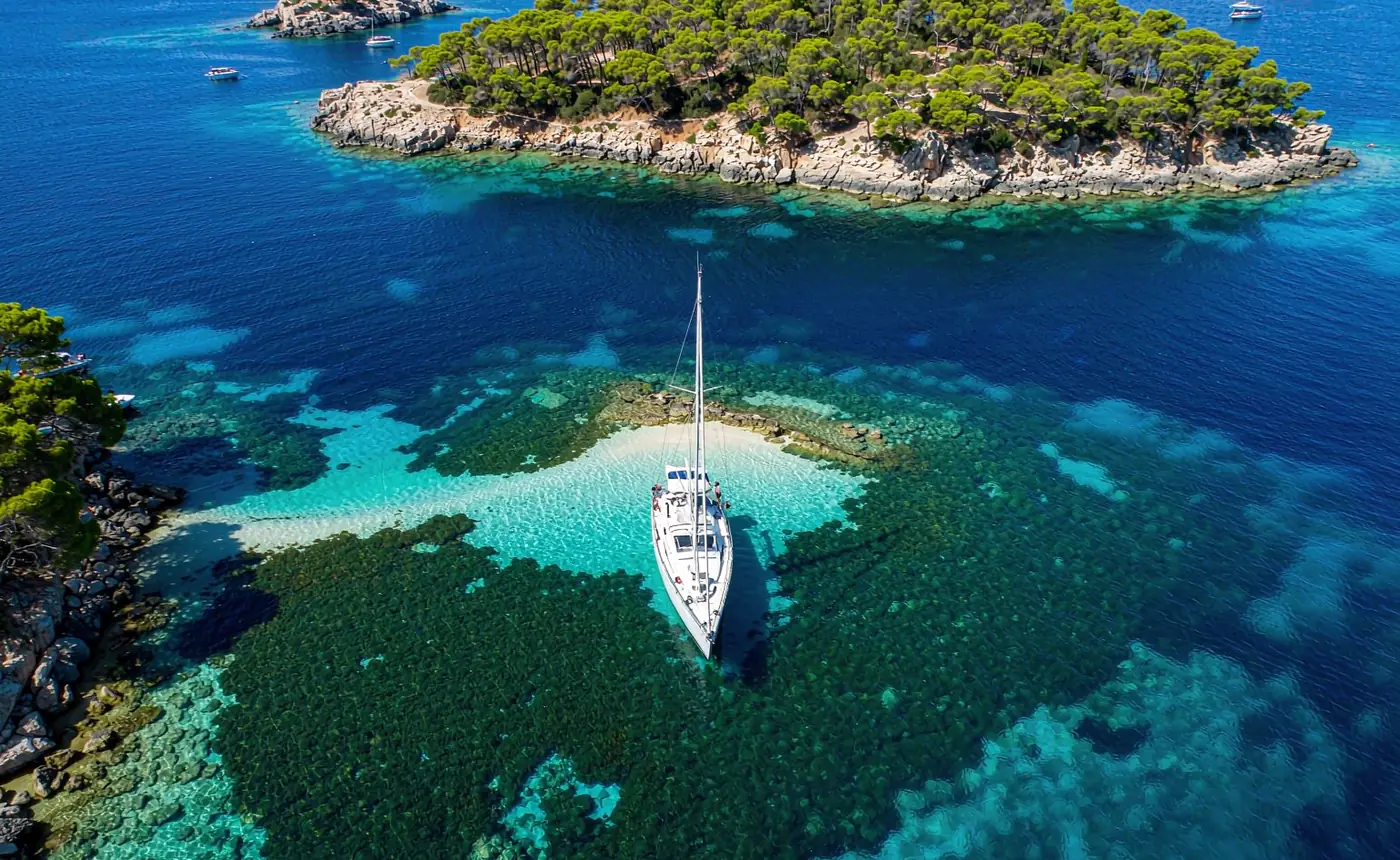
- Read the water. Dark green patches against pale sand, or ribbon-like leaves floating at the waterline and piled on the beach, mark meadows. Turquoise over light bottom is sand; dark bottom under clear water usually is not.
- Confirm with the sounder or a swim. Hard returns over a light, even bottom with scattered weed are sand; a soft carpet of dark green is the meadow. When in doubt, snorkel before the anchor goes down.
- Anchor on sand and lift vertically. Set the hook on the pale patch and, on retrieval, bring the bow directly over the anchor so the chain does not plough a trench backwards through the grass.
- Use the buoy fields and know the exception. Eco-moorings exist precisely for these bays — book them. In genuinely deteriorating weather, safety takes precedence everywhere and shelter is legitimate, but expect to justify the position afterwards.
The apps and buoy fields that keep you legal
Three tools cover the cruising grounds where the rules bite hardest. Donia (donia.fr) shows the seabed type under your position along the French coast, flags the no-anchor zones and lets you book the ten eco-mooring buoys at Cannes, Antibes and Beaulieu-sur-Mer directly — a fifth of what you pay funds seagrass restoration. Medtrix is the government-backed platform behind the French habitat maps. In the Balearics, the government's own Posidonia app and cartography list the red and yellow zones the patrols enforce.
Buoy fields are the substitute infrastructure, and the model is mature: the Bagaud mooring zone in France's Port-Cros national park bans anchoring year-round but maintains 68 buoys — sixty for vessels up to 15 metres and five for 15–30 metres — free to use during the day between mid-April and mid-October. Booking one costs less than one hour of a €90,000 problem.
Frequently asked questions
Do the anchoring bans apply to small boats too? Country by country. The French ban over Posidonia applies only to yachts over 24 m, with notification duties above 45 m and authorisation above 80 m. The Balearic decree covers every vessel regardless of size or flag. Greek, Italian and Croatian restrictions come mainly from marine protected areas, whose rules change zone by zone.
How do I know if the bottom is Posidonia before I anchor? Use the seabed maps before arrival — Donia and Medtrix for the French coast, the Balearic government's Posidonia app for Spanish waters. On the water: dark green patches against pale sand, ribbon leaves at the waterline, a soft carpet on the sounder. When in doubt, snorkel.
What happens if I'm caught on the meadow? In the Balearics, most crews are ordered to move — 4,813 detections against 18 fines around Ibiza and Formentera in 2025 — though the law allows €100–450,000. France sanctions the position itself: fines up to €150,000 plus sailing bans, and recent judgments have run from €10,000 to €90,000. Yachts can be held until fines are resolved.
Can I still anchor anywhere in the Mediterranean? Yes — sand, mud and rock outside protected zones stay open and free everywhere. Eco-mooring buoy fields are the intended substitute inside sensitive bays, and bad-weather shelter remains a right, subject to justification.
For the basin-wide fee picture — taxes, berth prices and the wind calendar — start with the Mediterranean destinations guide. The Turkey vs Greece clearing-in guide covers the paperwork side of the Aegean, the Croatia taxes and entry guide does the same for the Adriatic, the marinas guide compares 2026 berth rates when you want a dock instead of an anchor, and the weather and passage-planning guide helps you pick sand-friendly bays in the right wind.