The hour meter is a service clock, not a death clock. Most recreational marine diesels never reach the hours where a major overhaul is due — they die of neglect or corrosion long before the pistons wear out. Service on the 100–200 hour ladder, and the big money decisions arrive as a documented choice: a top-end overhaul from roughly $3,000–8,000 in-frame, an out-of-frame rebuild at $8,000–20,000, or a repower. This page shows where each threshold sits for your engine type, what the work actually costs in 2026, and how to read hours when you are buying the boat rather than owning it.
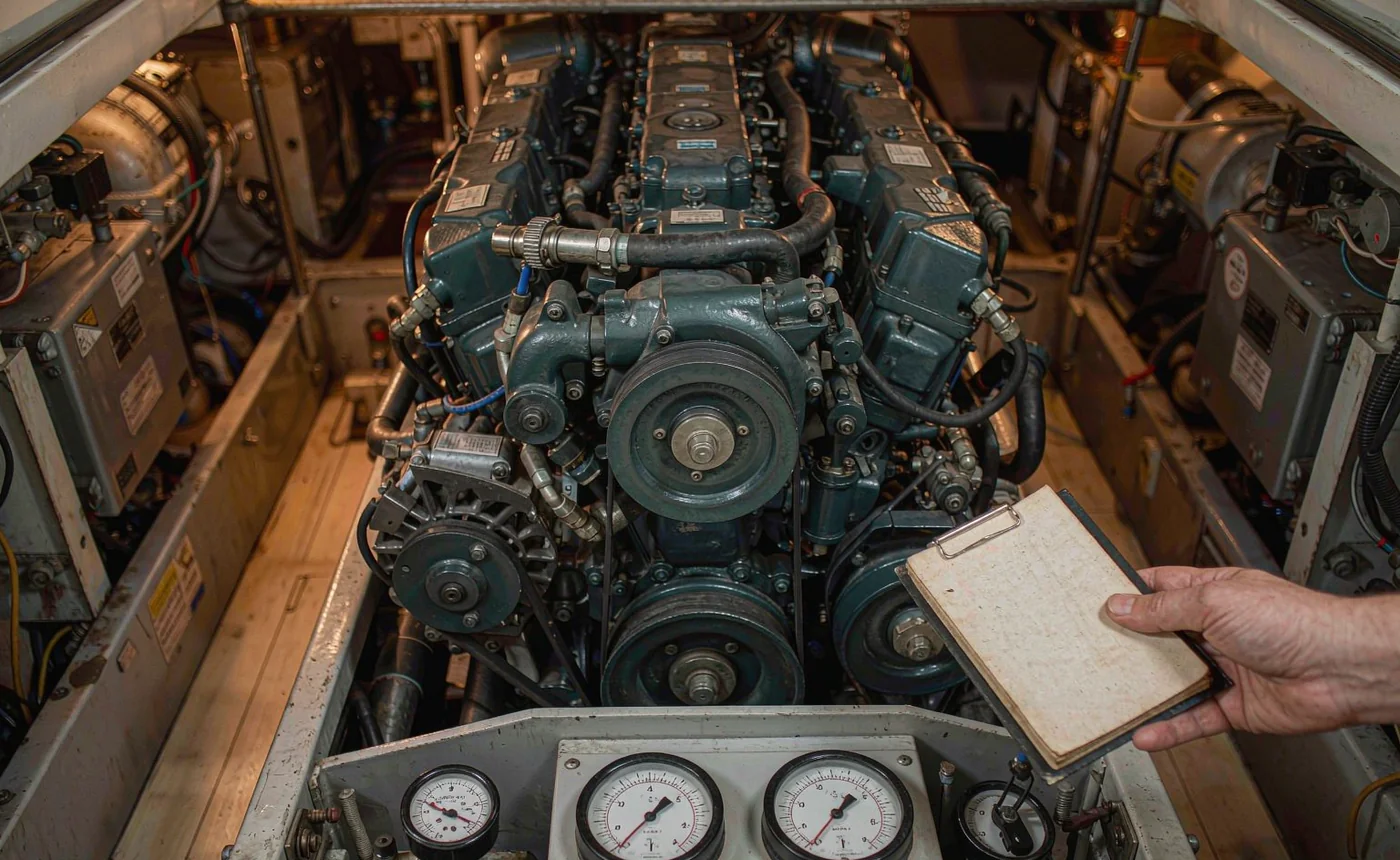
What engine hours actually measure
Hours measure running time, not wear. The same 2,000 hours can mean a decade of gentle coastal motor-sailing or three seasons of full-throttle channel crossings, and the difference is worth more than the meter reading. The first useful number is hours per year:
| Hours per year | What it says about the engine |
|---|---|
| Under 30 | Suspiciously low. Cold-running diesels suffer injector coking, hardened impellers, wet-exhaust corrosion and glazed bores — low hours are not automatically good hours |
| 50–150 | Typical private ownership on a sailing yacht or weekend motorboat. This is the profile that ages best, provided the annual service happened |
| 200–400 | Heavy private use or light charter. Fine if the service intervals were kept — ask for the log |
| 500+ | Commercial or intensive charter duty. Often better maintained than a low-hour pleasure boat, but everything else aboard will be tired |
The second number is the duty the engine was built for. A lightly loaded sail-drive auxiliary turning 1,800 rpm on passage accumulates almost no meaningful wear per hour; a high-output planing engine turning 3,800 rpm to make top speed wears several times faster for the same hour. That is why the figures in the overhaul section below vary by a factor of three between engine types.
The service ladder: hours that keep the overhaul away
Manufacturer intervals for recreational diesels settle into a narrow band, and staying on this ladder is what postpones every figure in the next section. Always defer to your engine manual — the ranges below are the typical published pattern:
| Interval | Typical work |
|---|---|
| Every 100–200 hours or annually, whichever first | Engine oil and filter; visual check of belts, hoses and connections |
| Every ~200 hours | Fuel filters (primary and secondary), raw-water impeller inspection, anode check |
| Every 500–1,000 hours | Transmission or IPS drive oil; valve clearance check; seawater pump service |
| Every 1,000–1,200 hours or 2–3 years | Timing belt, injection system check, full electronic diagnostic |
| Calendar items, regardless of hours | Coolant every 2–4 years, exhaust riser inspection, impeller replacement every 1–2 years, fuel polish |
Two habits do most of the preventive work. First, oil analysis (from about $30–90 per sample at marine labs) turns the annual change into a wear report — rising iron or coolant traces show up thousands of hours before a failure. Second, log the hours at every service: a stamped history is the single largest factor in what a buyer will later believe your engine is worth.
When the hour meter points at real work
Engines are rated by duty type, and the spread is wide. As a field guide — always check the manufacturer's own documentation for your model:
| Engine type | Typical service life before major work |
|---|---|
| High-output planing diesels (fast motor yachts, sportfish) | 3,000–5,000 hours to a structural top-end or significant intermediate work |
| Sailing yacht auxiliaries and sail-drives (20–75 hp) | Often quoted at 5,000–8,000 hours; most never get there |
| Trawler and displacement diesels at low steady load | 8,000–10,000 hours realistic with disciplined maintenance |
| Petrol sterndrives and inboards | 1,500 hours is already a lot; many are tired by 1,000 |
| Modern four-stroke outboards | 2,000–3,000 hours achievable; most trade well before |
Hours start the conversation; symptoms close it. The classic progression: compression readings drifting below spec or a labored start, oil consumption that has you topping up between services, blue smoke (oil past the rings), persistent white smoke after warm-up (compression or injection), and rising crankcase blow-by. Any two of those on a high-hour engine justify a compression test and an oil analysis before you authorise anything. For the fault-finding side — smoke colors, overheating, fuel problems — the diesel troubleshooting guide walks each symptom to its likely cause.
What an overhaul costs in 2026
Published yard pricing gives a usable ladder, though your quote will move with access and corrosion. European dealer price lists put a 500-hour major service (valve clearance, injection check, coolant) around €650, a 1,000-hour service (valve job, heat exchanger, alternator and starter, alignment) around €1,450, and a 2,000-hour top-end overhaul (pistons, rings, liners, bearings, injection, cooling deep-clean) around €2,950 per engine. US shops quote in-frame overhauls — the engine stays in the boat, 3–5 days — at $3,000–8,000, and out-of-frame rebuilds at $8,000–20,000 with 7–14 days of downtime. At the top end, dealers servicing high-output motor yacht engines routinely quote $15,000–40,000 for major work, and a Caterpillar service center's ~$10,000 estimate for a 2,500-hour "freshening" on a pair of commercial-rated diesels is a useful reality check. All figures are 2026 published ranges, before haul-out and before surprises.
Two cost traps worth naming. Raw labor rarely dominates — parts for a common auxiliary are modest, but a corroded exhaust riser, a scored transmission or a seized heat exchanger discovered mid-job rewrites the quote. And accessibility is money: an engine under a cockpit sole with hours of removal labor triples the identical job quoted in a open engine room.
Overhaul, rebuild or repower: deciding in five steps
- Buy evidence before work. A compression test and an oil analysis cost a few hundred dollars together and turn a mechanic's hunch into a measured decision. No overhaul should be authorised on symptoms alone.
- Price the repair against a replacement engine. Below roughly 60–70% of a new or exchange engine's cost, an overhaul on a healthy block usually wins. Approach parity and the calculus flips.
- Put downtime on the calendar. In-frame keeps the boat in the water for days; out-of-frame means haul-out and weeks. Charter schedules have killed more overhaul budgets than parts prices have.
- Check the neighbors first. The overhaul fixes the short block — not the sail-drive seals, transmission, risers, fuel tanks or 15-year-old wiring. A repower resets all of them at once; an overhaul leaves every other system at its current age.
- Do the resale math. A documented 2026 overhaul with receipts adds real value and survey credibility; an undocumented "it was rebuilt sometime" adds nothing. If you plan to sell within two years, price the work against what the survey will actually credit.
The annual-cost side of this decision — where engine service sits against berthing, insurance and the refit reserve — is laid out in the yacht maintenance checklist, and the routine oil-and-filter rhythm itself lives in the engine maintenance guide.
Reading the hours when you are buying the boat
Buyers over-index on the meter and under-index on the paper. Three questions beat any hour count. How many hours per year, and do they match the boat's story? Is there a stamped service history with hours recorded at each visit? And has an oil analysis or compression test ever been done — can it be done during your survey? A 2,000-hour engine with twelve dated invoices is the better risk than a 900-hour engine with none, and hours are only one line in the price conversation — the yacht cost guide shows where engine condition sits in the wider valuation, while the fuel efficiency guide explains why cruise rpm, not maximum hours, is what wears a diesel.
Frequently asked questions
Are 3,000 hours a lot on a yacht diesel? Depends entirely on duty. A 3,500-hour sail-drive run lightly is a healthy midlife engine; the same hours on a high-output planing engine approach the 3,000–5,000-hour top-end window; on a petrol sterndrive you are already shopping for a replacement powertrain.
How much does a marine diesel overhaul cost in 2026? Published European lists put a 500-hour service near €650, a 1,000-hour service near €1,450 and a 2,000-hour top-end near €2,950; US in-frame jobs run $3,000–8,000 and out-of-frame rebuilds $8,000–20,000, with high-output engines quoted to $15,000–40,000.
Do engines wear out from low use instead? Yes — and it is the more common path. Under about 30 hours a year, expect injector coking, hardened impellers and wet-exhaust corrosion. Steady 100-hour-a-year use with real servicing beats a 20-hour hangar queen.
Is it cheaper to overhaul or repower? Below roughly 60–70% of a replacement engine's price, overhaul the healthy block with documented evidence. Near parity — or with corrosion in the risers, transmission or block — repowering wins.