You felt the clunk through the deck, and now there is a vibration that was not there this morning: your prop has hit something. Before you touch the throttle again, the decision that matters is not the repair bill — it is whether you can safely get home. Restart only if there is no oil sheen near the stern drive or shaft seal, the engine holds gear normally, and the vibration is mild and stays mild at idle. Anything else, call a tow. This guide covers what a strike actually damages, how to tell a bent blade from a spun hub, what each repair costs in 2026, and how insurers treat it.
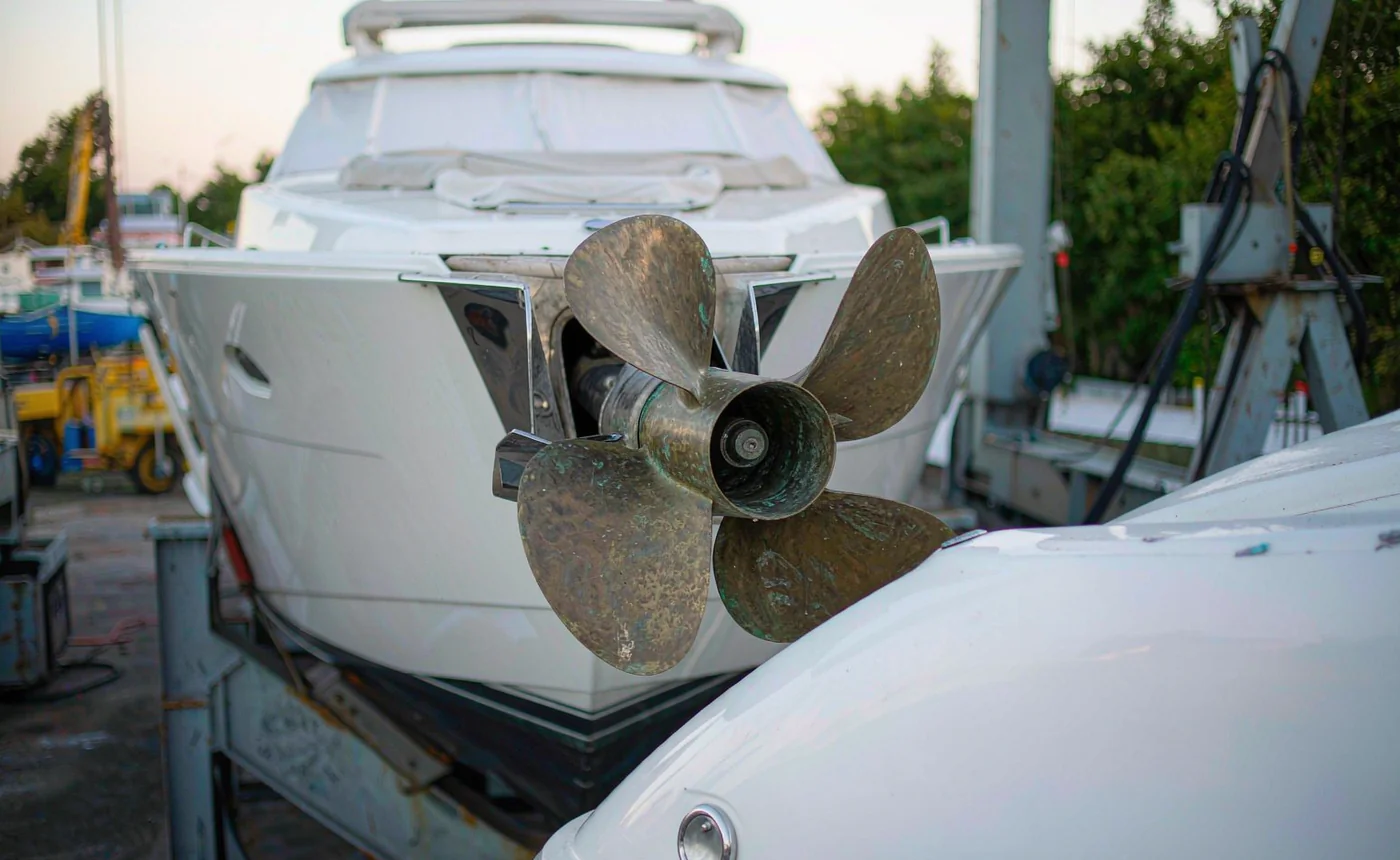
What a strike actually damages — it is rarely just the prop
The prop takes the hit, but the force travels up the driveline. On an inboard yacht the possible casualties, in rough order of expense, are: bent blades, a slipped rubber hub insert, a scored or bent shaft, a worn cutless bearing, a damaged strut or P-bracket, and — on a sterndrive or outboard — the gears, bearings and seals inside the lower unit. This is why a proper diagnosis starts with the prop off the shaft and a mechanic's eyes on the oil, not with a new prop bolted on over a bent shaft.
The hub is the designed sacrifice. Most props carry a rubber or plastic insert between the bronze and the shaft, meant to let go on a hard strike so the gearcase does not. The symptom is unmistakable: engine revs normally, boat barely moves. It is also the cheapest fix on the list — a hub kit runs $15–60.
First hour after the strike: check before you restart
- Stop and look astern. An oil sheen or milky traces near the lower unit or shaft seal means a seal has let go. Do not restart; water in the gear oil destroys bearings fast.
- Check the gear oil. On a sterndrive or outboard, crack the lower drain screw: milky or foamy oil confirms water ingress and points to a seal kit or rebuild, not just a prop.
- Test at idle, briefly. If there is no leak, engage gear at idle. The engine should hold gear without strange noises; vibration should be mild and should not worsen.
- Decide: limp or tow. Limp in at idle only over a short distance, with no leaks and tolerable vibration. Vibration strong enough to feel through the deck, a unit that will not hold gear, or any visible crack — call Sea Tow or TowBoatU.S., or hail a nearby vessel on VHF 16.
Running a damaged driveline "just to the dock" is how a $300 prop job becomes a lower-unit rebuild. If you are not confident about what is wrong, the tow is the cheaper option.
Bent blade, spun hub or bent shaft: how the diagnosis runs
A prop shop sorts this in one visit. Off the boat, the prop goes on a mandrel: blades are measured for tip deviation, the hub is torque-tested, and the shaft is checked for runout with a dial indicator while still in the boat. The order matters, because a vibration that survives a prop swap is telling you the problem is further inboard.
- Vibration that rises with rpm, thrust otherwise normal — bent or nicked blades. The fix is straightening and dynamic balancing at a prop shop.
- Engine revs, boat crawls — spun hub. Hub insert replacement, usually same-day.
- Vibration unchanged after refitting a known-good prop — suspect the shaft, cutless bearing or alignment. This is the expensive branch.
- Grinding or whining from the drive, metal flakes in the gear oil — internal lower-unit damage. Stop running entirely.
What the repair costs in 2026
These are planning ranges for North American yards, drawn from current prop-shop and yard rate cards; Mediterranean yards, especially superyacht yards, run noticeably higher. Use them to sanity-check quotes, not as quotes.
| Item | Typical 2026 range | Notes |
|---|---|---|
| Prop reconditioning (straighten + balance) | $150–400 per prop | Aluminium repairs often $100–150; stainless $200–400. Large inboard bronze/NiBrAl props scale up with diameter |
| New propeller | $200–700+ (stainless outboard sizes) | Yacht inboard props are priced per diameter and blade count; match diameter, pitch and spline exactly |
| Hub kit replacement | $15–60 | The designed sacrifice — cheapest fix on the list |
| Shaft alignment (single) | $150–400 labour | Twins roughly double it; bundled into bearing or seal jobs |
| New prop shaft, machined and fitted | $700–2,500 | Bronze; stainless costs more, plus installation and alignment |
| Cutless bearing replacement | $400–900 per shaft | Part is $40–150; the cost is pulling the shaft. Twins $800–1,800 |
| Lower unit seal kit + oil change | $350–600 | Minor leak on sterndrive/outboard |
| Lower unit rebuild | $800–3,500 | Gears, bearings, seals depending on extent |
| Haul-out, block, wash, launch | $15–30 per ft | A 40 ft boat: roughly $600–1,200 before any repair labour |
Two rules of thumb keep the bill sane. First, if a repair quote comes to about half the replacement cost of the part, replacing usually wins. Second, batch the work: the haul-out and access are the expensive part, so if the boat is coming out anyway, do the anodes, bearing, seal and prop in the same visit. That logic is exactly how the annual maintenance checklist treats running gear.
Insurance: what gets paid and what does not
All-risk hull policies generally treat a strike as sudden accidental damage. Grounding and collision cover explicitly includes damage to propellers and rudders under major European yacht policies such as Pantaenius, and agreed-value policies settle repairs on a new-for-old basis without deducting depreciation. The exclusions are the mirror image: gradual wear, corrosion and erosion are not covered, so a blade worn thin over seasons is maintenance, while a blade bent in an afternoon is a claim.
Two practical points decide how much you actually pay. The standard hull deductible — commonly 1–2% of insured value on many policies, with named-storm losses often double — comes off the top of the claim, so a $900 prop repair on a $1M hull with a 1% deductible is your money anyway. And insurers expect to be told first: photograph the damage, keep the damaged prop, and get the repair authorised before the yard starts. A claim for a strike also becomes part of the boat's record, which a buyer's surveyor will read at resale — worth remembering before you decide a small claim is "free".
Prevention: cheap habits versus one yard bill
- Keep the depth sounder on with a shallow alarm set. Most strikes happen in water the chart says is fine — shifting bars and uncharted debris do not read charts.
- Idle through skinny water, bow watch posted. Tilt an outboard or sterndrive as high as it will go while keeping steerage.
- Log the charted depth of your regular routes. A sandbar that moved over winter is the classic repeat offender.
- Carry a spare. A matching spare prop (diameter, pitch, spline), a hub kit, a prop wrench, spare nut and thrust washer turn a strike into a 30-minute anchorage job instead of a tow.
- Inspect the prop monthly in season. Nicks on leading edges grow into cracks; burrs from sandy bottoms file off in minutes with a mill bastard file.
None of this removes the risk — working harbours and shallow anchorages are where yachts go. It just moves the odds, and the odds are what your insurance premium and your yard bill are priced on.
Where this sits in the maintenance year
A strike is the acute version of what the propulsion systems guide covers in the long term: everything between the crankshaft and the water wears, and vibration is the shared symptom. If the engine itself is running rough without a strike in its history, start with the engine maintenance schedule and the diesel troubleshooting guide before pulling running gear. And if you are budgeting the year as a whole, the haul-out line in the maintenance checklist is where prop work belongs — batched, inspected and, with luck, uneventful.
Frequently asked questions
Can I keep running on a prop with a small nick? If there is no vibration and no oil sheen, yes, for the day. Get it inspected at the next service — leading-edge nicks grow into cracks. Vibration or a leaking seal changes the answer to no.
How do I tell a spun hub from a bent blade? Spun hub: engine revs, boat barely moves. Bent blade: vibration that rises with rpm. The hub is a $15–60 insert; the blade needs a prop shop.
Will insurance cover it? Sudden accidental strike damage is covered under all-risk hull policies, props and rudders included; wear and corrosion are not. The standard deductible applies, and the insurer should authorise repairs first.
Repair or replace the prop? The shop rule: if the repair quote is about half the replacement cost, replace. Aluminium props are usually cheaper to swap; stainless is usually worth straightening.