The letter on the builder's plate is a sea-state envelope, not a grade of build quality. A Category C 45-footer is not a worse boat than a Category B 45-footer — it was assessed against a different wind and wave range. For Mediterranean island hopping, C is usually enough. For an Atlantic crossing or a winter Biscay delivery, it is not. And the two numbers beside the letter, maximum load and maximum persons, are the ones your insurer will actually read out loud.
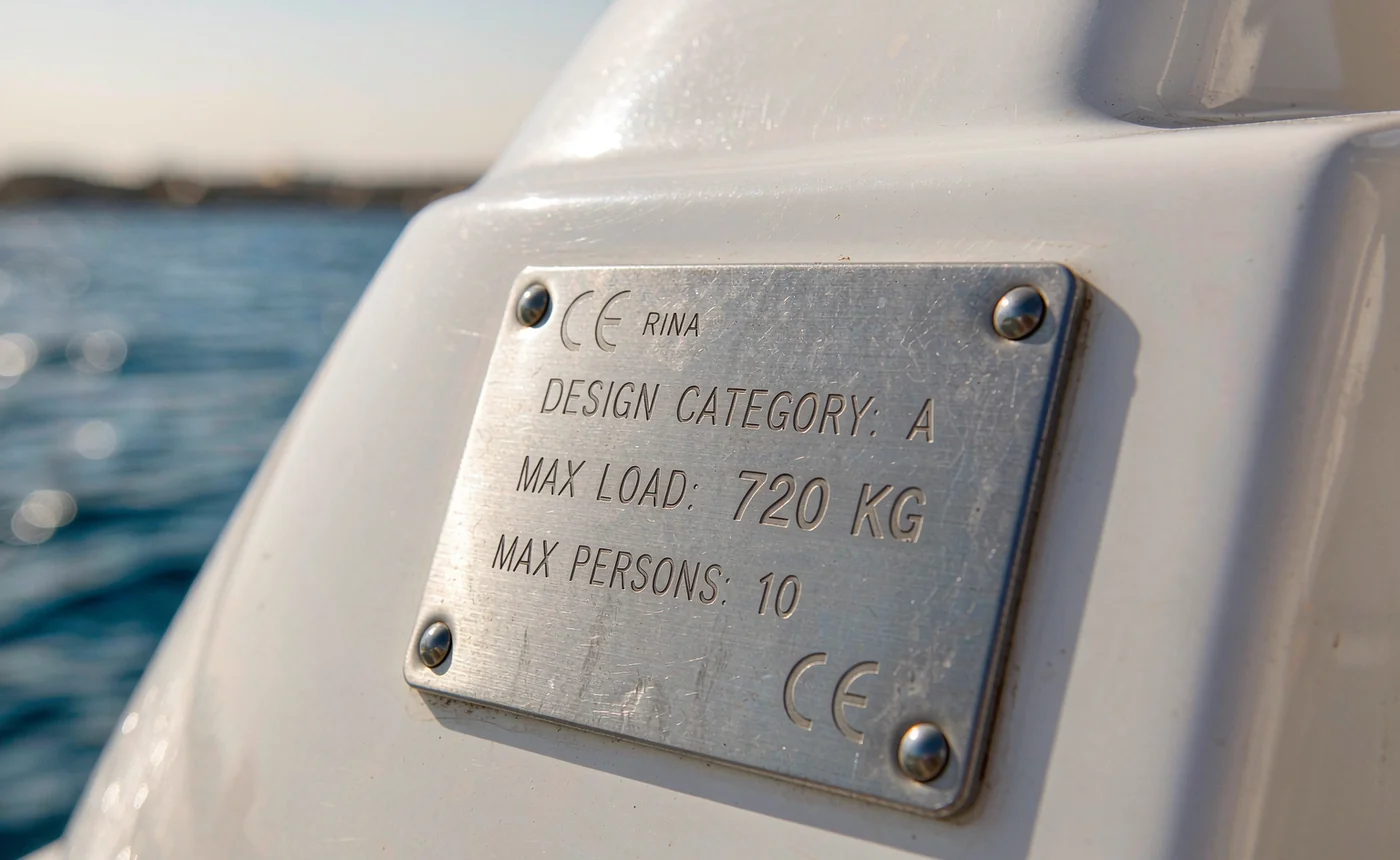
What the four letters actually certify
Design categories come from Annex I, Part A, section 1 of Directive 2013/53/EU — the Recreational Craft Directive, or RCD. Every craft placed on the EU market with a hull length between 2.5 m and 24 m carries one, and it fixes the wind force and wave height the hull, structure and stability were assessed against.
| Category | Wind force (Beaufort) | Significant wave height (H1/3) | Waters it describes |
|---|---|---|---|
| A — Ocean | exceeding 8 | exceeding 4 m | Extended voyages, largely self-sufficient; excludes abnormal conditions such as storms, hurricanes and rogue waves |
| B — Offshore | up to and including 8 | up to and including 4 m | Offshore passages made inside a realistic weather window |
| C — Inshore | up to and including 6 | up to and including 2 m | Coastal waters, large bays, estuaries, lakes and rivers |
| D — Sheltered | up to and including 4 | up to and including 0.3 m, occasional 0.5 m | Sheltered coastal water, small bays, canals |
Two definitions do most of the work. Significant wave height is the average of the highest third of the waves in a sea state, not the tallest wave you will meet — a 4 m H1/3 sea routinely throws 6 m crests, which is why Category B is a genuine offshore rating rather than a marketing label. Beaufort 8 is a gale at 34–40 knots with foam blown in streaks; Beaufort 6 is 22–27 knots, an ordinary unsettled afternoon in the Aegean.
Note what the directive writes into the Category A definition itself: winds above force 8 and seas above 4 m, "but excluding abnormal conditions, such as storm, violent storm, hurricane, tornado and extreme sea conditions or rogue waves." No recreational category promises survival in a storm. The letter says what the boat was designed to be used in, not what it will withstand.
Why a Category C boat is not a lesser boat
The category drives real engineering — scantlings, stability range, freeboard, the size of cockpit drains, and whether liferaft stowage is mandatory (it is for A and B, and for C and D boats over 6 m). Pushing a hull up a category costs structure and ballast, which costs displacement, speed and interior volume at the same length. Builders choose the category their customer will actually use, and a coastal cruiser optimised for C is frequently the better boat for coastal cruising: lighter, faster under sail, and with more cabin for the money.
The trap runs the other way too. Several well-known long-distance trawler and motorsailer models carry Category C plates despite a reputation for going anywhere, because their builders accepted the lower rating rather than re-engineer for a market they were not primarily selling into. It also means a plate is a snapshot of the rules in force when the boat was assessed, and those rules have tightened. Surveyors and brokers who have watched the same models re-certify over two decades generally agree that a boat rated B in the 2000s would often be signed off as C today. An older B plate is therefore worth more, not less, than the paper suggests.
What else is stamped on the plate
Annex I requires five items on a plate permanently fixed separately from the hull number. All five are worth photographing on a viewing, and one of them is routinely misread:
- Builder's name, trade mark and contact address — the entity that signed the declaration, which is not always the brand on the transom after a yard changes hands.
- The CE mark, followed by the four-digit number of the notified body where one was involved in production control. A number here tells you the boat went through third-party surveillance, not just self-declaration.
- The design category letter — the one item most buyers look at and least understand.
- Maximum recommended load in kilograms, derived from the load-capacity standard and excluding the weight of the contents of fixed tanks when full. This is the misread one. The figure on the plate is not the payload you get with full fuel and water; those tonnes come out of it.
- Maximum number of persons the craft was designed to carry. On a charter-coded or family boat this is the number that decides whether eight guests plus two crew is within the design brief or outside it.
Separately, the craft carries a 14-character Craft Identification Number to EN ISO 10087, moulded or stamped into the transom, usually on the starboard quarter near the gunwale. It encodes the manufacturer's country code, the builder's code, a serial number, the month and year of production and the model year. If the CIN has been ground off or a new one glassed over, stop and ask why — it is the one identifier that ties the hull to its file for life.
Five checks to run before you bid
- Photograph the plate, the CIN and the declaration. Then ask for the EU Declaration of Conformity, which is the document that links the plate's figures to the assessed design and the harmonised standards used. A plate without a declaration is a claim; a plate with one is a record. Owners lose these files constantly, and replacing them for a pre-2017 boat can mean a fresh assessment.
- Do the load arithmetic yourself. Take the plate's maximum load, subtract full fuel and water (diesel runs about 0.84 kg per litre, fresh water 1 kg), then see what is left for crew, tender, toys and stores. A 12 m cruiser-racer with 1,100 kg of rated load and 200 litres of fuel plus 300 litres of water has roughly 700 kg for everything else — six adults and their luggage.
- Match the category to your actual cruising plan. Category C covers the Mediterranean summer, the Croatian islands, the Balearics in season and the Solent. It does not cover a November Biscay delivery, an Atlantic circuit or a Caribbean season that starts with a 2,800-mile passage. If your plan includes those, you are shopping for B or A whatever the price says.
- Hunt for post-delivery alterations. A hardtop, davits, a genset, added tankage or stabilisers all add top weight and change the stability case. An engine replacement matters most: a power increase of roughly 15% or more, or any change to the emissions-relevant hardware, is normally the point at which a fresh assessment is required. On a used boat this surfaces as a plate that no longer describes the machinery in the engine room.
- Hand the numbers to the surveyor. The pre-purchase survey should confirm the stability documentation exists and that the boat still sits within its assessed load case — not simply that the hull is dry. The scope and cost of that survey are set out in our pre-purchase survey guide, and the sea trial that follows it is the other half of the same decision.
When there is no plate, or the plate does not travel
The obligation attaches to the act of placing a craft on the EU market, not to ownership. A boat already in EU use that changes hands between private owners inside the EU does not need a new assessment, which is why most brokerage sales in the Mediterranean are paperwork-checks rather than re-certifications. Three situations break that pattern:
- Importing a used boat from outside the EU. Second-hand craft brought in from outside the EU fall in scope regardless of age. Where the original builder never took responsibility for conformity, the importer applies for post-construction assessment (PCA) through a notified body under Article 23 and Annex V, supplying a technical file and keeping it available to authorities for ten years.
- A major conversion. Structural work, an engine change, altered steering or fuel systems, or a change in the rated number of persons can trigger PCA for whoever places the modified boat on the market.
- Crossing the English Channel in either direction. Since the UK left the EU, a pre-owned CE-marked boat moving from the UK into the EU needs recertification, and one moving into the UK needs a UKCA mark under the Recreational Craft Regulations 2017 — both via post-construction assessment and third-party verification. British Marine and the RYA put the cost at roughly £500–5,000 depending on the vessel. CE marking is still accepted for sale in Great Britain, so a boat with a CE plate does not need a second mark to be sold there.
The United States has no equivalent scheme: boats are built to US Coast Guard requirements and ABYC standards, and European yards routinely build US-spec versions with 120 V electrical systems and EPA-compliant engines. That is why a US-market boat imported into Europe lands in exactly the PCA situation above.
One 2026 change is worth knowing about but changes nothing for existing boats. Commission Implementing Decision (EU) 2026/550, published on 13 March 2026, added two standards to the harmonised list: EN ISO 8665-2:2024, which governs how the power of electric marine propulsion is measured and declared, and EN ISO 15085:2024 on protection from falling overboard and means of reboarding. The older EN ISO 15085:2003 references stay valid until 13 August 2027. Nothing here alters the A–D categories, and no owner is required to modify a boat already in service.
What the letter does to insurance and resale
Underwriters price on cruising range, named-storm cover and lay-up period, and they ask for the design category because it is the quickest external check on whether your stated plan matches the boat. The friction point is a C-rated boat insured for offshore passages in exposed water. Insurers in some markets began declining that cover for Category C hulls from around 2010, which is the moment the rating stopped being paperwork and started being money. Read the cruising-range clause before you assume a quote covers the trip you have in mind — the questions that move a premium are set out in our yacht insurance guide.
On resale, the effect is usually time rather than a fixed discount. A C-rated 45-footer is a perfectly sellable boat to a coastal buyer and a difficult one to a buyer with an Atlantic circuit in mind, so it sits on the market until the right buyer appears. A complete file — plate, declaration, engine documentation, service history — shortens that wait more reliably than any price cut. If the boat is going to change flag or leave the EU at some point, the flag and VAT position matters as much as the category, which is where the flag registration guide picks up.
For buyers working through a larger transaction, the sequence from letter of intent to closing is set out in the superyacht purchase process guide, and the all-in cost that sits around the purchase price — survey, tax, registration, commissioning — is broken down in what a yacht really costs in 2026. Read the plate first, though: it takes ninety seconds and it tells you whether the boat in front of you was built for the water you have in mind.
Frequently asked questions
Is Category A the safest rating? It is the widest envelope, not a safety verdict. Category A means the hull and stability were assessed for winds above Beaufort 8 and significant waves above 4 m. A well-kept Category B boat with sound rigging and current safety gear is a better offshore proposition than a neglected Category A boat with tired rigging and an out-of-date liferaft.
Can a yacht's category be upgraded? Not by negotiation, and rarely at a price that makes sense. The rating is the output of stability and buoyancy assessment under the EN ISO 12217 series, so raising it means structural or ballast changes followed by a fresh conformity assessment. Most owners change the boat instead.
Does CE certification expire? No. The marking stays with the craft for its life provided nothing has been altered that affects conformity. Age alone does not withdraw it — what lapses is the paperwork, and a boat sold without its declaration of conformity is harder to insure and slower to sell.
Do I need CE marking to buy a used boat inside the EU? Not for a boat already placed on the EU market that is changing hands between private owners inside the EU. A used boat imported from outside the EU, or one that has had a major conversion, does need post-construction assessment regardless of age.