At the dock a yacht can look perfect and still be unable to do its job: engines that idle smoothly can overheat under load, miss their rated rpm, or shake the helm at cruise. The sea trial is the on-water test that catches exactly this, usually run the same day as the survey haul-out. Treat it as a test with a plan, not a joyride — and write it into the purchase agreement as a contingency, so a genuine finding lets you renegotiate or walk with your deposit. Here is what to test, what it costs in 2026, and which readings matter.
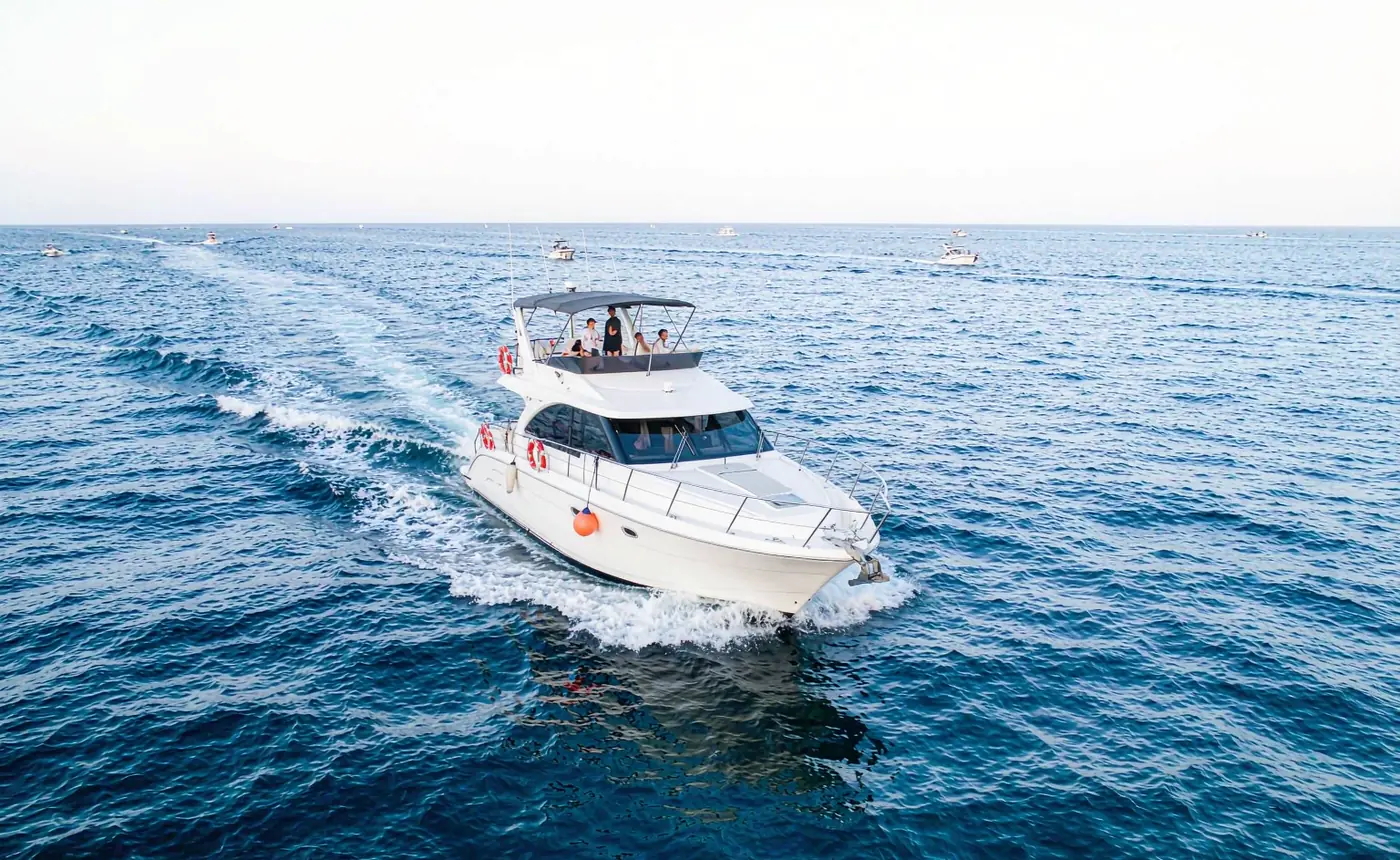
What a sea trial is and what it costs in 2026
A sea trial is an on-water run that tests engines, steering and systems under load — things no dockside inspection can show. In the US it is normally bundled into the pre-purchase survey: published 2026 surveyor rate cards put a pre-purchase survey with sea trial at $25–35 per foot, against $20–28 per foot for a Condition & Valuation (insurance) survey, which does not include an on-water run at all. Minimum fees of $750–850 mean small boats pay proportionally more. Expect extras: the haul-out is billed by the yard separately, and a dedicated engine survey adds roughly $500 per engine.
| Item | Typical 2026 range | Notes |
|---|---|---|
| Pre-purchase survey, sea trial included | $25–35 per ft | Minima $750–850 at the firms that publish rates; sailboats and cats run higher |
| Condition & Valuation (insurance) survey | $20–28 per ft | No sea trial — ABYC calls it insufficient for a purchase decision |
| Dedicated engine survey | ~$500 per engine | Recommended on high-hour engines; oil samples extra |
| Haul-out, short haul and relaunch | $230–360 (40 ft) | Yard invoice, separate from the surveyor |
For a 40 ft boat, an all-in day — survey, haul-out, engine survey and oil samples — lands roughly between $1,500 and $3,000. That is the cheapest bad news you will ever buy: the same document is what your lender and insurer will ask for anyway.
At the dock: paperwork, cold start and the first minutes
The most valuable part of the day happens before the lines come off.
- Insist on a cold start. Ask that the engines are not run for 24 hours before you arrive. Weak batteries, tired starters and fuel problems show up in the first cranking seconds — a warmed engine hides all of them.
- Match the paperwork. Hull ID and engine serial numbers against title, registration and service records. A mismatch is a walk-away on its own.
- Pick conditions. A morning with a little chop beats glass — vibration and hull-flex noises stay hidden on flat water.
- Agree the logistics. Who drives, who pays for fuel (by convention, usually the buyer), and how long you get. Bring a notepad and photograph gauge readings.
Confirm who is aboard. The surveyor works for you — you hire and pay them, and the report is yours to hand to your lender and insurer. On an older or high-hour boat, have a mechanic attend the trial; on sailboats, ask separately whether the rig needs its own inspection.
Watch the gauges, not the scenery. Oil pressure should come up within seconds; charging voltage should climb to the alternator's range. Look at the exhaust: clear is right, a thin blue haze that clears as the engine warms is common, but continuing blue smoke means burning oil, black smoke points to fuel delivery or an overloaded engine, and white smoke can mean coolant or unburned diesel. Confirm cooling water is actually flowing out. Then, still tied up, work the shifters, steering, trim and thrusters — gear engagement should be clean, with no clunk that feels like a penalty.
The number that matters most: rated wide-open-throttle rpm
Once on open water, run through idle, troll, cruise — then wide open. The single most telling number of the whole day is whether the engine reaches the manufacturer's rated WOT rpm. Surveyor's rule of thumb from the trade press: most V-8 gas inboards turn roughly 4,000–4,400 rpm at WOT; governed low-speed diesels run about 2,500 rpm and should land within about 50 rpm of it; higher-speed diesels turn roughly 2,800–3,400 and should be within about 100 rpm of the rated figure. Hold WOT for a few minutes if conditions allow and watch temperature stabilise.
- Cannot reach rated rpm — fouled bottom, mismatched or damaged prop, or an engine that no longer makes its power. Quantify which before you close.
- Rpm rises when you open the engine-room hatch — the engine is starved for air. Cheap fix, but it explains a sluggish boat.
- Surging at steady throttle — fuel delivery, not the sea state.
Temperature, smoke and vibration under load
At cruise, watch four instruments together: tach, speed, temperature, oil pressure. Temperature should settle and hold, not creep. A surveyor's infrared gun on the heat exchangers, exhaust risers and stuffing box finds what gauges miss — as a reference point, heat-exchanger flow shows a meaningful drop between inlet and outlet under load (on the order of 10°F or more), and a stuffing box more than about 20°F above ambient is usually overtightened. Vibration through the wheel or deck at steady rpm points at shaft runout, a damaged prop or worn cutless bearings; constant vibration at cruise is never normal, even if it is mild.
Before heading in, run the back-down test: hard astern, then briskly forward. The engine mounts should flex slightly — about an eighth of an inch at most — and show no play against the beds. It is a thirty-second test that catches loose mountings and tired transmission engagement.
Low-speed handling: the part buyers skip
Top speed is the fun number; docking is the daily one. Spend ten minutes in close-quarters work: shifts in and out of gear at idle, hard turns both directions, thruster response against wind, and a feel for how much rudder the boat needs to track straight. Buyers who skip this routinely buy boats that fight them every landing. Run every system under load while you are out — generator, air conditioning, electronics, autopilot, winches — because faults that never appear at the dock show up the moment everything is switched on and the hull is working.
After the run: engine room while it is hot
The most revealing look comes straight after tying up, with everything at temperature. Open the engine room and hunt for fresh drips, wet spots around hoses and fittings, fuel or coolant smell, and bilge water that was not there at the start. Confirm the bilge pumps cycle, then hot-restart each engine — a hard hot start is a classic warning sign. Feel hoses and belts for anything glazed or loose. Photograph everything while it is still wet.
Turning findings into price
Findings only earn money if you act on them the same week. Sort them into three piles: safety items to fix before you use the boat, repairs to price into the deal, and cosmetics you can live with. For the middle pile, a repair estimate in hand is what moves a seller — "the engine missed rated rpm" is an opinion, while "here is a $6,000 quote for the failed raw-water pump" is leverage. Because the survey and sea trial are written into the purchase agreement as contingencies, a material finding supports a price adjustment, repairs before closing, or walking with the deposit returned — the exact terms depend on your contract. If you are still assembling the budget around the deal, the true cost of owning a yacht puts this day in the context of the first-year spend, and the purchase process guide shows where the trial sits between offer and closing.
Pair the trial with the haul-out inspection — the two are scheduled together for a reason, and neither substitutes for the other. The survey guide covers what the surveyor checks out of the water; the broker selection guide helps you get the trial scheduled properly in the first place; and once the deal is signed, the insurance guide explains why the survey report you just paid for is also your underwriter's favourite document.
Frequently asked questions
How long should a proper sea trial last? Two to four hours for most production yachts — enough for a cold start, a full run to WOT, low-speed work and a hot engine-room check. Surveys on boats up to roughly 55–60 ft are typically finished in one day, trial included. Do not accept a lap around the harbour.
Can I skip it if there is a fresh survey? Only a pre-purchase survey normally includes operation under way. An insurance C&V survey does not, and ABYC is explicit that it is not sufficient to base a purchase on. Different product.
Who pays for the trial and the fuel? You pay the surveyor and, by convention, usually the fuel; the yard bills the haul-out separately, and an attending mechanic is an extra line. Agree it before the day.
The boat misses rated rpm — deal-breaker? Not automatically, but quantify it: fouled bottom and prop issues are a haul-out bill, an engine that cannot make rated power is far more. Get a quote and use it in the negotiation.