The survey report is a negotiating document, not a pass/fail certificate. Four findings reliably move money: osmosis on the moisture meter, engine hours that outrun the service file, rigging and deck core past their life, and expired safety gear. Surveyors and brokers who run these negotiations say buyers routinely recover 60–80% of the costed repair bill — which on a typical deal lands as a 5–15% reduction in price. One Mediterranean buyer watched a €120,000 purchase drop by €28,000 after the report itemised €32,200 of hidden work. Here is what each red flag is actually worth, and how to present it.
What the report actually hands you
A good report does three things a listing photo never will: it records hull moisture readings, it states which defects are urgent versus cosmetic, and — if you ask before the survey — it attaches an indicative repair cost to each finding. That last line is the one that pays for the survey. Ask your surveyor, when booking, to price the findings; brokers who negotiate these deals suggest requesting all or a reasonable share — 60–80% — of the total as a deduction. The alternative, letting the seller do the repairs before delivery, sounds tidy and usually is not: you cannot vet the yard he chooses or the quality of the work.
Two habits separate buyers who get the discount from buyers who get a counter-offer. First, negotiate the findings as one package, not line by line — a collective ask is harder to chip away at. Second, leave cosmetics out of it entirely; faded gelcoat next to a seacock problem tells the seller you will haggle over anything, which weakens the items that matter.
Osmosis: the reading that becomes a line item
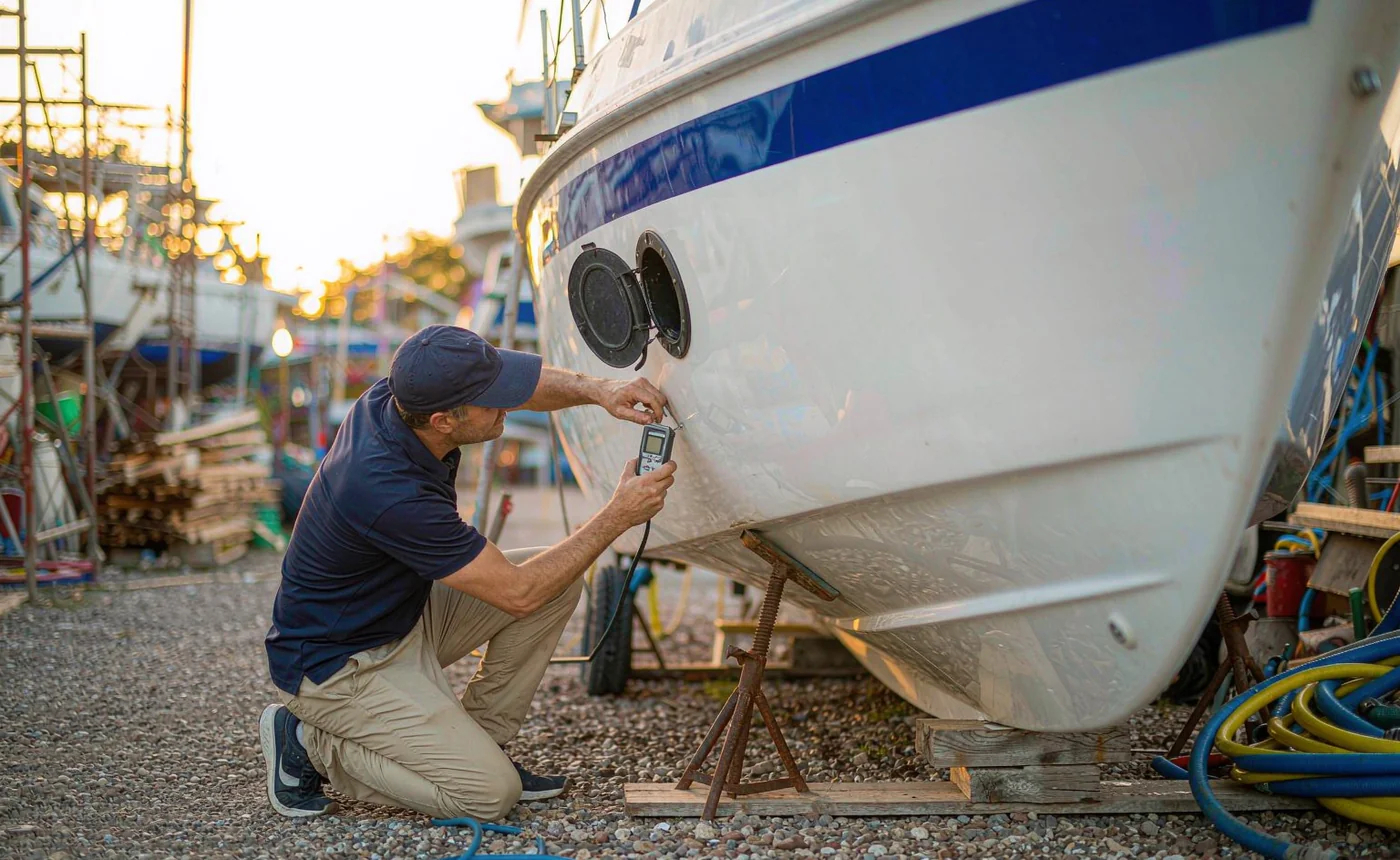
Moisture in a fibreglass hull is the most common real finding, and the only one where a number on a meter converts directly into money. The readings only mean something on a hull that has been out of the water for 24–48 hours — a freshly hauled boat reads wet everywhere and tells you nothing. Scattered small blisters are a maintenance item, not a crisis; saturation across the whole bottom is a scheduled project.
| Condition | What the report says | Indicative repair cost (35–45 ft) |
|---|---|---|
| Light | Scattered small blisters, moderate local readings | about $500–2,000 grind-and-fill; €1,500–3,500 in Med yards with barrier coat |
| Moderate | Widespread blistering, high readings over much of the bottom | €4,000–8,000 full gelcoat strip, 8–12 weeks drying, epoxy barrier |
| Severe | Deep blisters, readings high throughout, laminate suspect | €8,000–15,000+ peel, drying and laminate repair; $8,000–20,000+ US |
One detail worth a discount of its own: a fresh barrier coat with no paperwork behind it is a flag, not a feature. Applied over a damp laminate it hides blisters rather than curing them, and a report noting previous treatment without records justifies a moisture survey of your own (a standalone one runs roughly €350–600) before you concede the point.
Engine hours, smoke and the missing service file
A marine diesel that has been serviced commonly runs 5,000–10,000 hours, so the hour counter itself rarely kills a deal — the gap between the hours and the paperwork does. Sellers round down. In one Greek case the listing claimed 800 hours; the surveyor's records showed 2,100. That single discrepancy reframed the whole negotiation because it put every other claim in doubt.
The survey's cold start tells you more than the meter: white smoke that clears is normal, steady black or blue smoke is not, and oil in the coolant or a milky dipstick is an immediate conversation. Findings here get priced against the nuclear option — a repower on a 30–40 ft boat runs $12,000–25,000 installed — and a needed top-end overhaul or failed cooling circuit is a four-to-five-figure deduction waiting to be written down. Hours without records should be treated as a discount on their own: you are buying uncertainty, and uncertainty has a price.
Rigging, deck core and seacocks: the slow-money items
Standing rigging has a working life of roughly 10–15 years, and insurers care: original 1980s wire and chainplates sit outside standard cover, which makes them a discount item even when nothing has failed. A Mediterranean survey that priced rigging and chainplates replacement at €6,000–7,000 used it as the lead argument, alongside corroded seacocks at €1,200 — a flooding risk, not a maintenance note.
Deck core is the quiet one. Wherever hardware bolts through the deck, water finds the balsa or foam underneath; the surveyor's mallet hears it before your eyes do. Recoring a wet deck runs $5,000–15,000 and is among the most labour-intensive jobs on a boat, which is exactly why a few soft spots around the mast step or windlass deserve a line in your offer.
Paper gaps: expired gear and skipped services
The cheapest red flags to argue are the ones with a fixed service price. A liferaft and EPIRB out of certification since 2024 cost about €1,500 to put right — the survey that found them priced safety gear renewal at exactly that. Around them cluster the routine-but-unavoidable items surveyors list as immediate costs: raw-water impeller service, antifouling coming due, anodes eaten past half. Individually small, collectively they are the seller's own maintenance deferral, and asking him to fund it is reasonable rather than aggressive.
Five steps that turn the report into a discount
- Ask for costed findings before the survey. A report with a price per item is a negotiation document; a list of defects is an argument about opinions.
- Get one independent quote for the big item. A written yard estimate for the osmosis or rigging work anchors your number to something the seller can verify himself.
- Total the repairs and ask for 60–80% as a price reduction. Full recovery invites a flat no; most of the bill, in writing, usually moves.
- Offer the alternative: seller-funded repairs before delivery. Some sellers prefer it — but insist on invoices and your own inspection at handover, or you inherit the workmanship risk.
- Set your walk-away before the phone call. Practitioners use the 20% line: when costed repairs exceed a fifth of the price and the seller will not engage, the contract's survey clause exists to let you exit with your deposit.
When to walk away instead of negotiating
Three findings change the conversation from price to exit. Structural damage — a cracked bulkhead under the mast step, hull delamination, a bent shaft — means the boat is a project priced as a yacht. A history of hard grounding the seller did not disclose (ask directly; inspect the leading edge of the keel) is a honesty problem that the survey only partially bounds. And a registry or engine-serial mismatch, like the 50 hp documented against a 75 hp block found in one Spanish survey, is small money but signals the paperwork, and possibly the insurance, is built on sand. Walk from those; negotiate everything else. For what the survey itself costs and how to book one, the yacht survey guide covers the process, and the sea trial checklist covers what the report cannot see from the hard.
Frequently asked questions
How much discount can I realistically ask for? Buyers who present costed findings typically recover 60–80% of the repair bill — a 5–15% price reduction in practice. One Greek buyer turned €32,200 of findings into a €28,000 reduction on a €120,000 boat. Full recovery of the bill is a rare outcome; most of it, documented, is normal.
Is osmosis a reason to walk away? Almost never. Small blisters are a few hundred to a couple of thousand dollars; even a full strip-and-dry on a 35-footer runs $8,000–20,000, which is a negotiation number. The exit case is saturation with suspect laminate where the repair approaches a fifth of the boat's value.
Are high engine hours a problem? Hours without records are the problem. A serviced diesel commonly does 5,000–10,000 hours, so 1,500 documented hours beats 400 undocumented ones. Price any overhaul finding against the $12,000–25,000 repower bill for a 30–40 ft boat.
What should I leave out of the negotiation? Cosmetics. Faded paint and upholstery wear dilute a structural ask and stall the deal over trivia. Keep the list to safety items and repairs with real invoices behind them.
Where these numbers fit in the total cost of ownership, the yacht price and cost-of-ownership guide carries the full 2026 tables; the buying mistakes guide lists the traps that come before the survey, and choosing the right intermediary for the negotiation itself is covered in the broker selection guide.